

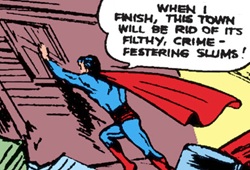
Art by Joe Shuster
Although the Superman of the 1930s fought against bank robbers, corrupt politicians, and racketeering gangsters by using a heavy hand and fist, he was more sympathetic in January 1939 when he came across a gang of juvenile delinquents. At first the Man of Steel protected them from the police and tried reasoning with them before turning to President Franklin Roosevelt’s New Deal in an attempt to save them from a life of crime.
During a session of juvenile court on the opening pages of Action Comics #8, young Frankie Marello stands before the judge, charged with assault and battery. Just as he is about to be sentenced, his mother addresses the court. “Wait, your honor,” she pleads. “Of course he talks tough. What’s more, he is tough, your honor. But he’s only like all the other boys in our neighborhood. Hard, resentful, underprivileged. He’s my only son, sir. He might have been a good boy except for his environment. He still might be – if you’ll be merciful.”
Among those watching the proceedings is ace news reporter Clark Kent. He silently agrees with Mrs. Marello, but also knows that the judge will likely show no mercy. Sure enough, the youth is sentenced to two years in a boy’s reformatory. Elsewhere in the courtroom, one of Frankie Marello’s friends remarks, “It’s Gimpy’s fault Frankie’s getting’ a rap.”
Later that evening, Clark Kent changes into his Superman persona and follows Frankie’s friends to Gimpy’s basement safehouse. Seeing all the money that Gimpy has been busy counting, they ask why he didn’t use some of it to hire an attorney for Frankie, as well as demand a cut for themselves. Instead of responding, Gimpy hires them to pull off a series of robberies, then calls the police to anonymously tip them off about the upcoming crime spree.
The conversation is cut short when Superman suddenly appears and rips the phone from the wall. He then pushes Gimpy in the face and onto the floor, picks him up and throws him against the wall before telling him that he has one hour to permanently leave town. With Gimpy taken care of, Superman rushes to find Frankie Marello’s friends before they get arrested by the police.
Superman scoops up the first youth just as the cops are moving in on him. Since the second has already been arrested, Superman has to rescue him from the police van taking him to jail. The third has actually made his way into the house he was assigned to rob and is in the middle of escaping with his bounty when Superman arrives. A fourth, meanwhile, manages to saw off the steel bars over a window at yet another residence before being whisked away by the Man of Steel.
After releasing the quartet of wannabe criminals in a darkened alley, Superman tells them, “You’ve gotten it into your heads, somehow, that it’s smart to steal. That stolen money is ‘easy dough.’ But that’s not true. No doubt you’ve already learned that no matter how much you bring in, Gimpy keeps the lion’s share. What’s more, you’ve always the fear that the law will make you pay the penalty for your crimes.”
As part of the New Deal, the National Youth Administration was created in 1935 to assist – in the words of an aide to FDR confidante Harry Hopkins – those who had “grown up against a shut door,” adding that “the young are rotting without jobs and there are no jobs.” According to historian William E. Leuchtenburg in his 1963 book Franklin D. Roosevelt and the New Deal, the NYA alleviated the problem by providing part-time employment for over 600,000 college students and 500,000 high school students over the course of seven years.
Another 2.6 million youths not attending school were also aided, helping to build tuberculous huts in Arizona, constructing a milk barn in Texas, renovating a schoolhouse in North Dakota, and landscaping a park in Michigan.
Instead of agreeing with Superman, one of the youths sneaks up behind him and whacks him with a wrench. “That was a mean stunt to pull after what I’ve done for you!” the Man of Steel shouts back. “I’m afraid there’s only one thing left for me to do, and that’s to throw a little fear and humility into you.” Grabbing the quartet in his arms, Superman runs, leaps, backflips, and balances himself on a telephone wire before returning them safely to the ground. As opposed to the desired effect, however, the foursome reply that the experience was “fun.”
They’ve also now found someone to look up to, and promise to walk the straight and arrow if that’s what Superman wants. “It’s not entirely your fault that you’re delinquent,” Superman tells them. “It’s these slums, these poor living conditions. If there was only some way I could remedy it….”
The superhero’s thoughts are drowned out by the words “Extra! Extra!” The newspaper being peddled contains the headline, “Cyclone Hits Florida, Cities Laid to Waste!” and gives Superman an idea. “So the government rebuilds destroyed areas with modern cheap-rental apartments, eh?” he says to himself after evacuating everyone from the area. “Then here’s a job for it. When I finish, this town will be rid of its filthy, crime-festering slums!” He then uses his super strength to tear down every building he encounters. The police unsuccessfully try to stop him, adding to the damage.
Although the replacement of slums with low-cost housing was under consideration during the early years of the New Deal, it failed to make any headway. Over a four-and-a-half-year period, for instance, the Public Works Administration either started or completed just forty-nine low-cost housing projects that contained less than twenty-five thousand new residential units. In Franklin D. Roosevelt and the New Deal, William Leuchtenburg placed part of the blame on the Roosevelt administration’s unwillingness to coerce the real estate industry, insurance companies, and building trade unions into going along with the plan.
When a group of New Yorkers later petitioned for a separate federal agency to undertake slum clearance measures, meanwhile, they got little sympathy from a president who believed more in rural living as opposed to urban. It wasn’t until 1937 that President Roosevelt finally supported a federal housing bill sponsored by Senator Robert Wagner. Afterwards, the new United States Housing Authority was granted the authority to issue $500 million worth of loans for low-cost housing. Although the results were better than those of the Public Works Administration, they were still modest at best – by 1940, only 350 new projects were completed or under construction.
Superman had far better success with his own slum clearance project – once all of the wreckage was removed, construction began on new apartment complexes that replaced the slum with a livable community. “You can tell your readers that we’ll spare no effort to apprehend Superman,” the chief of police informs Clark Kent. “But off the record, I think he did a splendid thing and I’d like to shake his hand.”
Anthony Letizia
Explore more Comics and History: The 1930s and 1940s on Remixing History