

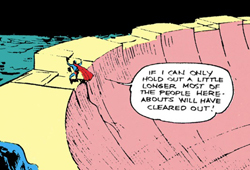
Art by Joe Shuster
Out of all the legislation passed and federal agencies created under President Franklin Roosevelt’s New Deal, one of the most successful was a series of public works projects undertaken by the government during the 1930s. In addition to providing temporary employment for millions of Americans desperate for a job, the Public Works Administration oversaw the construction of schools, roads, bridges, and buildings across the United States, including dams that provided hydroelectricity to nearby cities and prevented flooding in the region.
Although the fictional city of Metropolis was never a beneficiary of the Public Works Administration, the early DC Universe saw its fair share of public works programs during the decade nonetheless, courtesy of Superman. The opening page of Action Comics #5, for instance, begins with the words, “Telegraph lines broadcast to the world news of a terrible disaster! The Valleyho Dam is cracking under the strain of a huge downpour. Should it give way, a mountain of water will sweep down the valley, killing thousands and destroying the fertile land.”
In the mind of Daily Star editor-in-chief George Taylor, there is only one person for the job – Clark Kent. With the newspaper reporter nowhere to be found, Lois Lane volunteers to take his place, only to be told by Taylor, “It’s too important! This is no job for a girl.” Determined to prove him wrong, Lane tracks down Kent and asks him to cover her latest assignment, the pending deliver of septuplets at the City Hospital’s maternity ward. She then purchases a ticket on the last train to Valleyho.
Upon arriving at the hospital, Clark Kent is informed by a nurse that he was misinformed. When he then returns to the Daily Star, George Taylor not only chastises his ace reporter for missing the train to Valleyho but fires him for good measure as well. Instead of collecting his final paycheck as instructed, Kent instead transforms into his alter-ego Superman and races to Valleyho to both cover the story and save the day.
Harry Hopkins was selected by Franklin Roosevelt as head of the newly created Federal Emergency Relief Administration in May 1933 and launched the Civil Works Administration shortly afterwards. By the following January, the CWA employed 4,230,000 everyday Americans who were in need of a job, paying them minimum wage to build or improve 500,000 miles of roads, 40,000 schools, 3,500 playgrounds and athletic fields, and 1,000 airports. Specific projects included Montana’s State Capitol Building and the Cathedral of Learning at the University of Pittsburgh.
It wasn’t long, however, before Roosevelt became concerned by the rising cost of the CWA – as well worried that federal employment might be seen as a permanent solution for the Great Depression – and instructed Hopkins to scale back the number of projects once the winter months ended. “We must not take the position that we are going to have a permanent depression in this country,” the president said at the time.
According to David M. Kennedy in his 1999 book Freedom from Fear: The American People in Depression and War, 1929-1945, the Emergency Relief Appropriation Act of 1935 “breathed new life” into the CWA’s sister organization – the Public Works Administration – and transformed its once cautious director Harold Ickes into “a builder to rival Cheops,” a reference to the Egyptian pharaoh responsible for the Great Pyramid of Giza. The Lincoln Tunnel and La Guardia Airport in New York City, the Overseas Highway in the Florida Keys, and the San Francisco-Oakland Bay Bridge in California were all constructed under the PWA, as well as numerous roads, schools, courthouses, and hospitals across the country.
As he makes his way to Valleyho, Superman inevitably catches up with the train carrying Lois Lane to the same destination and quickly passes it. Further along, however, the Man of Steel comes across a bridge whose support beam has become loose because of the heavy rainstorm. Realizing that bridge is in no condition to safely carry the train across, Superman pushes the failing beam upward until the train safely passes overhead.
The rescue mission allows Lois Lane to arrive in Valleyho before Superman. She hails a taxi to take her to the dam but the driver gives her the car instead, explaining that he plans on taking the next train out of town. Superman, meanwhile, is now busy trying to keep the dam from breaking apart so that everyone has enough time to leave the area. The inevitable happens nonetheless. As the superhero races alongside the rushing water, he suddenly discovers that Lois Lane and her taxi are directly in its path.
The Wilson Dam – located on the Tennessee River near Muscle Shoals, Alabama – was constructed to assist with the production of explosives during World War I. It wasn’t completed until after the conflict ended, however, and left dormant afterwards. Attempts were made by the federal government to use the dam’s hydroelectric capabilities but private utility companies always managed to block the legislation. After seeing the facility for himself shortly before taking office, Franklin Roosevelt not only supported government intervention but saw an even greater potential, saying in April 1933, “The Muscle Shoals Development is but a small part of the public usefulness of the entire Tennessee River.”
According to historian William E. Leuchtenburg in his 1963 book Franklin D. Roosevelt and the New Deal, the resulting Tennessee Valley Authority was thus created to not only generate and distribute hydroelectric power from the existing Wilson Dam but build additional dams for flood control, produce fertilizer for local farmers, combat soil erosion and deforestation, create a 650-mile navigable waterway from Tennessee to Ohio, promote conservation, and develop recreational facilities. “I’ll tell them it’s neither fish nor fowl,” Roosevelt said of the project. “But, whatever it is, it will taste awfully good to the people of the Tennessee Valley.”
The U.S. Army Corps of Engineers, meanwhile, constructed the Bonneville Dam near Portland, Oregon, and the Grand Coulee Dam in the state of Washington during the 1930s under the auspices of Public Works Administration. Once completed, the latter created a 150-mile-long artificial lake that provided water for irrigation to eleven thousand farms and produced enough hydroelectric power to supply eight western states and parts of Canada.
Before Superman can reach the taxi containing Lois Lane, the vehicle gets caught in the rushing water. The Man of Steel, however, is still able to rescue her from drowning. Holding an unconscious Lane in his arms, he again races the flooding waters until he passes it, then leaps on top of a nearby mountain and uses his superstrength to crumble the large extrusion. The resulting avalanche of rocks blocks the rushing torrent just as it arrives, sending the flooding waters in a different direction and saving the town of Valleyho.
After dropping off a love-struck Lois Lane – who steals a kiss from her rescuer – at Valleyho, Superman transforms into Clark Kent and places a call to Daily Star editor-in-chief George Taylor. After explaining that he took a plane to Valleyho and confirming that he still has a job, Kent provides details on how Superman not only saved the day but built a new dam in the process.
Anthony Letizia