

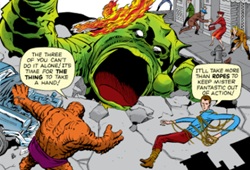
Cover art by Jack Kirby
At his inauguration in January 1961, President John F. Kennedy proclaimed, “Let the word go forth from this time and place, to friend and foe alike, that the torch has been passed to a new generation of Americans.”
Seven months later, Marvel Comics released the first issue of the Fantastic Four, likewise announcing that a new generation of superheroes, flawed and more human in nature, were ready to take the world by storm. Editor Stan Lee and his bullpen of writers and artists consciously crafted storylines that they themselves would find interesting rather than gear them towards a young teen audience. This decision resulted in the real world – “the world outside your window,” as they often said – being tied into many of those narratives. The pages of Marvel Comic during the 1960s were thus filled with stories pertaining to Civil Rights, the Vietnam War, campus protests, Women’s Liberation, and even the environment.
Initially, it was the Cold War between the United States and Soviet Union that most influenced Marvel. The Space Race, for instance, served as the backdrop for the creation of the Fantastic Four. Scientific genius Reed Richards built his own spacecraft but rather than wait for an official launch by the government, he – along with Benjamin Grimm, Sue Storm and her brother Johnny – snuck onto the military installation where the rocket sat and launched it themselves.
Grimm initially believed it was a rash decision – not enough research had been conducted, he argued, on the potential effects of the cosmic rays they would encounter on the trip – but was swayed by Sue Storm to go along with Richards’ plans nonetheless. “Ben, we’ve got to take that chance,” she tells him. “Unless we want the Commies to beat us to it.” Ben Grimm turned out to be prophetic nonetheless when the craft entered the cosmic storm that he warned about, with the aftereffects transforming each crew member into what became collectively known as the Fantastic Four.
While Stan Lee – like most Americans at the time – was a true believer when it came to the Cold War, he also had a strong anti-hate streak that likewise became a staple of Marvel Comics during the 1960s. Within the pages of the Fantastic Four, for instance, the team of superheroes squared off against the Hate Monger, described by Reed Richards as “the most dangerous type of menace. He preaches class hatred, race hatred, religious hatred.” During a rally organized by the Hate Monger, the large crowd of supporters chant, “Long live the Hate-Monger – he’ll clean up this country for us. Down with all foreigners! Down with everybody who disagrees with us! Hail to the Hate-Monger!”
After being blasted by the Hate Monger’s H-Ray, the Fantastic Four turn against each other and go their separate ways. With the help of Nick Fury, however, they are later able to shake off the effects and defeat the supervillain. “Until men truly love each other regardless of race, creed or color, the Hate-Monger will still be undefeated,” Reed Richards reminds his fellow superheroes afterwards. “Let’s never forget that!”
While the Fantastic Four had the Hate Monger and the real world had the Ku Klux Klan, the Avengers had the Sons of the Serpent. “We call ourselves serpents because the serpent is feared by all, just as we shall be,” the Supreme Serpent tells the crowd at a recruitment rally in New York City. “Those who wear the serpent’s robes shall one day be master of all. Our enemy must know that we will show them no mercy. As the original serpent drove Adam and Eve from Eden, so shall we drive all foreigners from this land.”
At the end of the narrative, it is revealed that the Sons of the Serpent were merely part of a communist plot, with the Supreme Serpent himself turning out to be a Chinese general visiting the United Nations. “All I had to do was make Americans distrust each other, and then hate each other,” he explains. “For a fearful nation becomes a divided nation, and a divided nation is a weak nation – a nation ready for conquest.”
As the realization of how close Chen came to succeeding hits everyone, Goliath remarks, “Let’s never forget the lesson we’ve learned here today – beware of the man who sets you against your neighbor.” Captain America then adds, “For whenever the deadly poison of bigotry touches us, the flame of freedom will burn a little dimmer.”
The impact that these storylines had on the growing legion of Marvel fans was reflected in the letter pages of the comic books. In Avengers #78, for instance, one reader wrote, “As a potential parent, I would rather that my children read your comics and saw the personifications of bigotry and hate vanquished by your heroes, than having them read the papers and finding out that good does not always triumph. Thanks for the beautiful, meaningful story and thanks for accepting the role as a catalyst in the shattering the opaque window of bigotry and distrust.”
Another reader added in Silver Surfer #10, “Is it bad if children are taught that people can hate others for ridiculous reasons? Is it bad if an adult is reminded, just once more, that we don’t live in a perfect world, that people do suffer, and that it can be helped? Nobody is asking you to tell fables; don’t get on a box and preach. Your stories are still fantasy, good fantasy. But, how can it be wrong if you’re trying to build a better world?”
Iron-Man wasn’t the only Avenger to visit Vietnam during the 1960s, as Captain America and Thor likewise made the trip. Cap and Spider-Man, meanwhile, found themselves in the midst of numerous college campus protests. And when Daredevil was unable to prevent a bomb from exploding during a protest outside the hotel where the Vice President of the United States was staying, famed CBS anchorman Walter Cronkite told a live television audience, “It’s far too early to know how many were injured in the blast, or how many will be hurt in its aftermath, but one thing is certain. A tragedy which may parallel that of 1968 in Chicago seems in the making here” – a reference to the violent clash between police and protesters at the Democratic National Convention.
During the real-world Watergate scandal that forced President Richard Nixon to resign from office, Captain America faced his own sense of disillusionment just like the rest of the country. The multi-issue narrative revolves around a plot to discredit Cap at the same time that a Secret Empire is plotting to take control of the country. While the Secret Empire is ultimately defeated, its leader – known simply as Number One – initially escapes, only to then find himself cornered by Captain America in the White House. Although his face is never shown, the villain turns out to be the President of the United States.
Afterwards, Steve Rogers hangs up the shield of Captain America but later reconsiders his decision. “The people who had custody of the American Dream had abused both it and us,” he says to himself. “There was no way I could keep calling myself ‘Captain America,’ because the others who acted in America’s name were every bit as bad as the Red Skull.” He then pauses and repeats the line. “Every bit as bad as the Red Skull. And yet, I didn’t want to know about those people. The Skull was okay to oppose, and still is, but Number One wasn’t because he was supposed to be on our side. If I wasn’t prepared for any and all threats to the American Dream, then what was I doing as Captain America?”
He then concludes with the words, “I guess what I’m saying is, there has to be somebody who’ll fight for the Dream, against any foe. Somebody who’ll do the job I started. And God knows I can’t let anybody else run the risk that job entails for me.”
From the inauguration of President John F. Kennedy to the resignation of Richard Nixon, Marvel Comics created a fictional history that went hand-in-hand with the factual 1960s – one that not only reflected the times but had an impact on it as well.
Anthony Letizia