

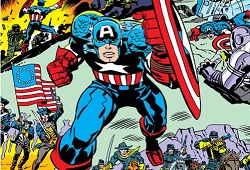
Cover art by Jack Kirby
In his 1980 review of the recently published A People’s History of the United States by Howard Zinn, Eric Foner of the New York Times wrote, “The 1970’s witnessed an unprecedented redefinition of historical studies – a byproduct of the ferment of the 1960’s – in which the distinctive experience of blacks, women, Indians, workers and other neglected group moved to the forefront of inquiry.”
Zinn was the first historian of notoriety to embrace this new approach. “He is refreshingly candid in announcing his purpose,” Foner noted at the time. “Too much history, he contends, is written ‘from the point of view of governments, conquerors, diplomats, leaders.’ His ‘People’s History,’ by way of contrast, sides with the losers, the downtrodden, the underdog. It is a book ‘disrespectful of governments and respectful of people’s movements of resistance.’”
Close to forty years later, another historian – Jill Lepore – likewise wrote a one-volume history of the United States entitled These Truths. “There is, to be sure, a great deal of anguish in American history and more hypocrisy,” she explains in the introduction. “No nation and no people are relieved of these. But there is also, in the American past, an extraordinary amount of decency and hope, of prosperity and ambition, and much, especially, of invention and beauty. Some American history books fail to criticize the United States; others do nothing but. This book is neither kind.”
In 1976, legendary comic book creator Jack Kirby both wrote and illustrated the close to eighty-page Captain America’s Bicentennial Battles, in which the famed superhero is tricked by the sorcerer Mister Buda into traveling through time, witnessing firsthand two hundred years’ worth of U.S. history. Similar to Howard Zinn, Kirby’s history strays from the traditional focus of government and instead spotlights the downtrodden and the underdog. But like Jill Lepore, Kirby’s history is also filled with decency, hope, and beauty. As Mister Buda tells Captain America at the beginning of his journey, “You serve the people! See them, in their vices and their virtues, their heartbreak and joy!”
Captain America’s first destination is colonial Philadelphia, where Benjamin Franklin notices his red, white, and blue costume and summons Betsy Ross, who uses the design to make her famous first flag. “It isn’t possible!” the superhero shouts in the disbelief. “It just isn’t possible! I’ve been ripped-off by Benjamin Franklin!” Although a humorous take on the classic “chicken or the egg” paradox, it likewise implies that even the Founding Fathers had their flaws and were far from perfect.
From there, Captain America travels to the Great Depression. “Y’look like an actor who just lost his job,” someone tells him. “Well, there’s a lotta guys without jobs – these are hard times. If you’d like, I can steer you to a soup kitchen that hands out free meals.” After politely excusing himself, Cap comes to the rescue of a paperboy who has been shoved to the ground by a notorious gangster. “Lock him in the cooler, Clancy,” the boy shouts to a police officer afterwards. “Nobody’s safe in this town while cheap hoods like Lefty are cruisin’ around.”
As the words fade, Captain America find himself in the American Southwest and face-to-face with Geronimo. “The troopers hunt us, and we ambush them,” the Apache leader explains. “Thus, the killing goes on until we are dead or free.”
“Liberty or death!” the superhero replies. “Those words are truly American, Geronimo. Sometimes I wonder how we can be brothers and strangers at the same time. And yet we are. We are Americans who must find each other – and in doing so, become as one people.” Geronimo, however, simply responds, “Your words are leaves in the grip of the wind. Soon the bullets will fly, and it is the bullets which decide what is truth in this place.”
When the U.S. Calvary appears on the horizon, Geronimo and his followers take their leave in order to fight another day. Captain America instead runs towards the Calvary, shouting, “Stop! Stop! Listen to me, there is another way! We’re all Americans!” It is to no avail, of course, and Cap soon finds himself again in the presence of Mister Buda, demanding to be released from his time-traveling journey.
“So, the great superhero is uncomfortable with the sharing of human events,” Mister Buda replies. “You want to lead a parade and smile to the crowds. You think this kind of thing is the total sum of your country. Is this the shallow façade that is Captain America?”
“I’ve never been fool enough to believe that this country is made of heroic monuments or fanciful accounts, created to inspire people to patriotic fervor,” the superhero later contends, to which Buda responds, “Yes, you’ve known it, the triumphs and the tragedies – the people at their best, and at their worst – men building, and destroying. But your conclusion is rather hasty, I’d say. However, with the little time left to you for further insight, you may yet stumble upon the truth.”
As his journey recommences, Captain America finds himself encircled by a gang of gun wielding “slave catchers” returning a runaway slave to the South. “You have no right to take this man,” the superhero tells them. “If this is free territory, then you’re the trespassers.” The words only incise the bounty hunters, who decide to hang Captain America for interfering. The son of a local rancher is watching from afar and fires his rifle as a distraction, which Captain America and the runaway slave use to knock their adversaries unconscious.
As the Black man resumes his trek northward, the local rancher approaches his son to see what all the ruckus was about. “The men on the ground are slavers, paw,” the boy says. “I helped a fugitive get away.” The comic book then reveals that the father is actually John Brown, who would later lead an attempt to incite a slave rebellion by raiding Harper’s Ferry, Virginia, in 1859.
Captain America is next transported to a barren desert in New Mexico. Two soldiers in an army jeep recognize him and whisk him away to an underground bunker to witness the detonation of the world’s first atomic bomb. As he watches the explosion, Captain America suddenly finds himself surrounded by flames – only he is no longer in New Mexico but the city of Chicago during the Great Fire of 1871. The superhero immediately springs into action, preventing a resident from entering his burning home to retrieve his possessions and leading others to the river and safety.
“There’ll be nothing but a mountain of ashes when the fire dies down,” someone says, to which Captain America replies, “That won’t faze Americans. They’ll build a new city here – a city they’ll write songs about.”
In the end, Captain America comes to understand what Mr. Buda has been trying to teach him. “People trying to make it,” he says of the history of the United States. “That’s what it’s all about. Men, women, groups and individuals – winning and losing and going on, when life kicks ’em in the backside. Yes – and dying, to keep the process alive.”
In one final gesture, Mr. Buda transports Captain America to the present and a group of children, boys and girls of all races. “I’m looking for something bigger than any super-villain,” he tells them. “And I think I’ve found it here, among you young people. It isn’t an object, exactly – it’s a terrific feeling that we can become strong and smart enough to beat the overwhelming problems which every American has to live with.”
After the kids announce that they will someday be superheroes as well, Captain America continues. “That’s America! A place of stubborn confidence – where both young and old can hope and dream and wade through disappointment, despair and the crunch of events – with the chance of making life meaningful!”
Anthony Letizia