

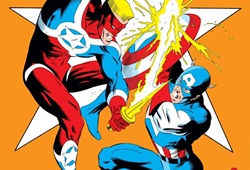
Cover art by Mike Zeck and John Beatty
In the April 1986, Village Voice reporter Jack Newfield wrote an essay for Playboy magazine entitled “Stallone vs. Springsteen: Which Dream Do You Buy?” in which he analyzed the competing forms of patriotism evoked by the two leading popular culture heavyweights of the time period.
“Bruce Springsteen and Sylvester Stallone are the two great working class heroes of American mass culture,” Newfield wrote. “Springsteen had the best-selling album of 1985 and Stallone had the second most successful movie. On the surface, they share stunning similarities of biceps, bandannas, American flags, Vietnam themes, praise from President Reagan and uplifting feelings of national pride. But beneath the surface – and between the lines – these two American heroes in the Eighties are sending opposite messages. They are subtly pulling the 18-to 35-year-old generation toward two competing visions of the American future.”
Sylvester Stallone emerged from obscurity with the Oscar-nominated Rocky, the story of a down-and-out boxer who suddenly has a shot at the world heavyweight championship. In a subsequent sequel, however, the narrative strays from its dramatic roots into a patriotic showdown between American Rocky Balboa and the Soviet Union’s Ivan Drago.
In 1992, meanwhile, Stallone starred in First Blood as Vietnam Veteran John Rambo, a one-man army who takes down corrupt police officers in the state of Washington and later heads back to Vietnam in the even more popular Rambo: First Blood Part II to rescue American POWs left behind after the conflict ended.
“Stallone’s Rocky and Rambo films – especially the latter – are about violence and revenge in a context of fantasy,” Jack Newfield explained in Playboy. “Rambo never pays a price in body bags or pain or blood or doubt or remorse or fear. The enemy is stereotyped and therefore dehumanized. The emotions Stallone liberates are hostility and aggression: Audiences come out of the theater wanting to kick some Commie ass in Nicaragua.”
Three months after Jack Newfield’s essay appeared in Playboy, the character of Super-Patriot – aka John Walker – was introduced by Marvel Comics in Captain America #323. Although Walker would eventually evolve into a short-lived replacement for Steve Rogers as Captain America before taking the moniker of U.S. Agent, he was initially conceived by writer Mark Gruenwald as the Marvel equivalent of Sylvester Stallone’s Rambo.
“I’ve been getting a lot of letters that said ‘you should do Captain America more like Rambo,’” Gruenwald said in a 1988 interview. “And personally, I don’t feel in my reading of the character that there’s any way Steve Rogers could become like that. So I said, if they want Captain America like Rambo, I’ll give them it, but it can’t be Steve Rogers.”
He added in the same interview, “I realized that because Captain America was the good guy, it seemed to be saying patriotism had to be good because patriotism was Captain America and he was the good guy. So I wanted to show the dark side of patriotism, so I invented the character Super-Patriot to show that.”
According to Jason Olsen in his 2021 book Mark Gruenwald and the Star Spangled Symbolism of Captain America, 1985-1995, “Walker’s patriotism, much like Walker himself, is aggressive and violent, built on cynicism and confrontation. He indeed matures from his days as Super-Patriot, but his view of the world, while perhaps becoming more nuanced, evolves in a relatively limited way. Roger’s approach to patriotism is about people and inclusion. Walker’s leans more toward exclusion and an elevated view of the state.”
At a “Make Super-Patriot the Living Symbol of America” rally in Central Park in Captain America #323, an announcer tells the crowd, “It gives me great pleasure to present to you America’s brand new Sentinel of Liberty… that valiant defender of democracy… the hero with his finger on the pulse of the Eighties… the one, the only – Super-Patriot!”
Super-Patriot has secretly hired a fake group of Captain America supporters to act as a personal nemesis and give him something to fight. Known as the “Buckies” – after Cap’s sidekick Bucky from World War II – they attack Super-Patriot once he gets onstage. “A true patriot need not cower behind a weapon,” Super-Patriot tells them. “A true patriot is a weapon – for freedom and peace!”
On the opening pages of Captain America #327, meanwhile, the Buckies attack an International House at the University of Wisconsin. “Libyan, Algerian, Iranian,” one of them says. “Yer all the same. Yer all out to do America dirt, and this is one proud American who ain’t gonna stand for it!” Afterwards he says to another Buckie, “Roughin’ up a bunch of un-American slimeballs sure does my patriotic heart good.”
When the group later meets with Super-Patriot, the same Buckie tells him, “Hey, boss, you really oughta come with us on one of a’our campus capers. You’d have a ball puttin’ the fear of the flag in some a’ those pencil necks.” Super-Patriot agrees but adds that his agent is still conducting market research to see if it would be good for his image. He does concede, however, that “my gut feeling tells me that the public goes for the strongarm stuff.”
Bruce Springsteen was elevated to rock and roll stardom with his 1975 album Born to Run but it was his 1985 megahit Born in the U.S.A. that turned him into a pop culture icon. Although the soaring chorus of the title song elicited the same flag-waving sense of patriotism as a Rocky Balboa or John Rambo, the verses themselves told another story – a disillusioned Vietnam veteran unable to build a life for himself after returning home from the war.
“Bruce Springsteen’s patriotism is rooted in a different set of values, apparent in his songs: the old-fashioned virtues of work, family, community, loyalty, dignity, perseverance, love of country,” Jack Newfield wrote in Playboy. “His fundamental theme is the gap between America’s promise and performance and his resilient faith in the eventual redemption of that promise. He sees America as it is, with all of its jobless veterans, homeless people and urban ghettos. And he retains his idealism in spite of everything, because his patriotism has room for paradox. At a Springsteen concert, one song makes you want to cheer for America, the next makes you want to cry for America – and then change it.”
The same could be said of Captain America. “Some folks misunderstand me,” the character says in Captain America #322, the issue before Super-Patriot is first introduced. “They think I represent the American government, it’s political system, or its official policies. I don’t. I represent the American dream – the notion that human beings should have the opportunity to better their lives and attain their noblest aspirations.”
He later elaborates further in the same issue. “I’m not a knee-jerk patriot. I don’t believe in my country right or wrong. I support America in its concept, its essence, its ideal. Its political system, its foreign and domestic policies, its vast book of laws – I am not America’s official advocate of any of that. What I represent are the principles that America’s politics, laws, and policies are based upon. Freedom, justice, equal opportunity.”
In Playboy, Jack Newfield argued that the primary difference between Sylvester Stallone and Bruce Springsteen was the same as the one between nationalism and patriotism as defined by George Orwell in his 1945 essay Notes on Nationalism. In regards to the former, Orwell wrote, “I mean the habit of identifying oneself with a single nation or other unit, placing it beyond good and evil and recognizing no other duty than that of advancing its interests.” As for patriotism, “I mean a devotion to a particular place and a particular way of life, which one believes to be the best in the world but has no wish to force upon another people.”
During the 1980s, Rocky Balboa and John Rambo wrapped themselves in the American flag and sent the message that the United States would no longer be kicked around by other countries. Wrapped in that same flag, Bruce Springsteen wrote songs about everyday Americans struggling to make a living. The same sense of nationalism portrayed by Balboa and Rambo was incorporated by Mark Gruenwald into the character of Super-Patriot, while the patriotism of Springsteen – as well as his unwavering belief in the American Dream – was personified by Captain America.
During a backstage battle at an AmericAid benefit concert in Captain America #327, Super-Patriot tells Captain America, “Trouble with you, grampaw, is your concept of America and her ideals is as dated and obsolete as you are! You’re out of step with America – you don’t know what makes this country and the people tick anymore.”
“America’s ideals are timeless,” Cap counters. “Liberty, justice, and the pursuit of happiness never go out of style.”
Ironically, Super-Patriot ends their battle prematurely because Bruce Springsteen is about to go onstage. “Really, gramps, I’d love to stick around and finish you off,” he says. “But I can do that anytime. How often will I hear The Boss perform from ten feet away?”
Anthony Letizia