

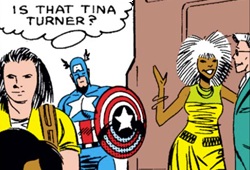
Art by Paul Neary
In Captain America #327, Steve Rogers heads to Madison, Wisconsin, ostensibly to visit his former girlfriend Bernadette “Bernie” Rosenthal but also to track down a trio of fake Captain Americas who are intent on portraying the superhero as a “reactionary bigot.” When Rogers mentions that they work for someone called Super-Patriot, Rosenthal immediately recognizes the name.
“I was just reading something about him,” she says. “Wait. Where was it? Time, Newsweek? No, here it is, in Rolling Stone.” She then hands Steve Rogers an article entitled “Rock and Roll Patriotism” before adding, “I think Super-Patriot is one of the guests at the AmericAid concert this weekend in Milwaukee.”
As Gilda Berger writes in her 1987 book USA for Africa: Rock Aid in the Eighties, it all started when a group of British musicians united under the name Band Aid and recorded a single in late 1984 – “Do They Know It’s Christmas?” – in order to raise awareness and money for the famine-ravaged country of Ethiopia. A few months later, the feat was duplicated on the other side of the Atlantic Ocean when forty-six American artists recorded “We Are the World” under the moniker USA for Africa. Later that summer came Live Aid, a full-day benefit concert held in both London and Philadelphia and watched on television by 1.5 billion people across the planet.
It wasn’t just famines and Africa, however, as the fifteen-hour Farm Aid proved in September 1985, designed to raise awareness on the plight of the American farmer and brought in millions of dollars in donation as well. The following year, it was the homeless and hungry of the United States who were the benefit of Hands Across America, during which close to five million men, women, and children – as well as ten elephants – attempted to build a 4,150-mile human chain across the country while raising money for charity.
Steve Rogers and Bernadette Rosenthal arrive at AmericAid ’86 just a Willie Nelson finishes singing the words to his classic hit “On the Road Again.” Afterwards Nelson tells the crowd, “Thank all of you for showing up here this afternoon, and particularly thank you for showing all the cynics, who thought that helping the world’s needy was just a fad, that they’re wrong. As long as there’s poverty and hunger anywhere in this great ol’ nation of ours, we’ll be there, you and me, and we’ll each of us do our part.”
The 1970s were a time of prosperity for the American farmer. Demand was high both domestically and abroad, while government subsidies ensured record profits. As a result, many farmers took out loans to buy additional land and livestock, as well as new farm equipment. Then came the recession of 1981. Not only did prices on the open market drop but the value of farmland decreased as well. Many farmers could no longer make the monthly payments on their loans from the previous decade as a result, and it wasn’t long before banks began foreclosing on their property.
Bob Dylan rarely addressed the audience during his performances, but Live Aid was an exception. “While I’m here I hope,” he began. “I’d just like to say I hope that some of the money that’s for all the people in Africa, maybe they can just take a little bit of it, maybe one or two million maybe, and use it, say, to pay the mortgages on some of the farms that farmers owe to the banks.”
Country star Willie Nelson didn’t perform at Live Aid but watched and heard Bob Dylan’s off-the-cuff remark on television. He immediately enlisted the aid of John Mellancamp and Neil Young to help organize the first Farm Aid concert on September 22, 1985. Governor James R. Thompson donated the use of Memorial Stadium at the University of Illinois, arrangements were made with both radio and television networks for broadcast, and phone banks were set up for people to call in and make donations.
Farm Aid began at 9:45 a.m. in a heavy rain that continued for the next three hours. Although Willie Nelson was a country music star and farms are often considered country music territory, Farm Aid was about more than one genre as performers ranged from banjo players to heavy metal artists, punk rockers to folk and blues singers, rap groups to rock bands. Amongst the acts that took the stage were Alabama, the Beach Boys, Bob Dylan, John Fogerty, Merle Haggard, Billy Joel, B.B. King, Loretta Lynn, Kenny Rogers, and the MCs. Fifteen hours after it began, Farm Aid ended with Willie Nelson singing “Amazing Grace” and a fireworks display. Close to ten million dollars was raised but more importantly, millions of people across the country were made aware of the plight of the American farmer.
Switching into his Captain America persona, Steve Rogers uses his Avengers ID card to gain backstage access at AmericAid. “Wow!” Captain America thinks to himself. “It’s like the who’s who in pop music back here. Thanks to Bernie broadening my musical tastes while we were an item, I actually recognize most of these musicians. Is that Tina Turner?”
A woman who appears to be folksinger Joan Baez, meanwhile, debates Super-Patriot about the contradiction of someone who supposedly represents “freedom and liberty” wearing mask. As she walks away, a member of Super-Patriot’s entourage asks, “Di’nt you usedta sing ‘If I Had a Hammer?’” to which she replies, “Ha-ha, no, that was Peter, Paul, and Mary.” Bob Dylan, Bruce Springsteen, and Mick Jagger are also reportedly performing, while others in the crowd wonder about Madonna and Run D.M.C. Even Steve Rogers jokingly says to Bernadette Rosenthal, “What? No Talking Heads? Maybe I can get my money back.”
Super-Patriot later addresses the crowd while Tom Petty and the Heartbreakers are setting up their equipment. “Hi, Americans!” he begins. “I call myself the Super-Patriot, and just like each and every one of you here, I love this supercharged country of ours. After all, America invented Rrrock ’n’ Rrrollll! And that’s what we’re all here for today, isn’t it? To share the spirit, the pride, and the fun! But let’s not forget the other reason why we’re here. We’re here to support the farmers… the factory workers… the families who can’t party with us ’cause there’s no food on the table or roofs over their heads.”
Although four million of the forty-four million dollars raised by “We Are the World” went to help the needy in the United States, many felt that wasn’t enough. “The most common thing I heard was, ‘That’s good what you’re doing for Africa, but what are you doing for Americans?’” Ken Kragen, co-organizer of the charity recording, admitted. “It was a take-care-of-home-first attitude, and I kept hearing this in a lot of ways.”
Kragen eventually decided that the best way “to help Americans help Americans” was to organize the largest “get together” in the history of the United States. “In order to make a difference, you have to do something major that captures attention,” he said at the time. “This is just impossible enough to be possible.”
Hands Across America was held on Sunday, May 25, 1986. Six million people donated at least $10 each to form a 4,150-mile human chain across the country. Standing at the head of the line in New York City was six-year-old Amy Sherwood, whose family of seven had been homeless for close to a year. She was joined by New York Governor Mario Cuomo, Harry Belafonte, and Yoko Ono. In Washington, D.C., President Ronald Reagan and First Lady Nancy Reagan joined hands with 225 staff members along the north portico of the White House. Near the end of the line in Long Beach, California, Ben Vereen remarked, “This is the richest country in the world. There’s no excuse for hunger.”
The human chain made its way across sixteen states, through five hundred communities and one jail, two deserts, one mountain range, and across ten rivers. People of all ages and backgrounds participated, while corporations like Coca-Cola covered the $18 million in expenses. American Express, meanwhile, flew people to Arizona to fill the route’s “toughest mile,” a stretch of barren desert. An estimated $20 million was raised to help the country’s hungry and homeless – a feat that even Captain America and Super-Patriot would both agree was an impressive achievement.
Anthony Letizia