

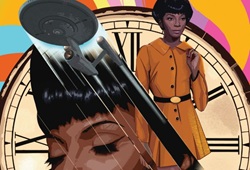
Cover art by Mark Alvorado
According to her 1994 memoirs Beyond Uhura: Star Trek and Other Memories, Nichelle Nichols had just made the decision to leave the television series after its first season when she was introduced to a fan at a NAACP fundraising event. His name was Martin Luther King, Jr., and he was dismayed to learn of Nichols’ decision to put Star Trek behind her.
“You must not leave,” the civil rights icon told her. “You have changed the face of television forever. You have created a character of dignity and grace and beauty and intelligence. Don’t you see that you’re not just a role model for little Black children? You’re more important for people who don’t look like us. For the first time, the world sees us as we should be seen, as equals, as intelligent people – as we should be. There will always be role models for Black children; you are a role model for everyone.”
Close to sixty years later, Nichelle Nichol’s Star Trek character Lieutenant Nyota Uhura likewise met Martin Luther King, Jr., only this encounter took place in the one-shot comic book Star Trek: Threads of Destiny, published in February 2026. On the opening pages, the crew of the USS Enterprise investigates an anomaly on a nearby planet and discovers a strange man simply named Carl and a device similar to the Guardian of Forever from the season one episode “The City on the Edge of Forever.”
As Carl shows them screens containing key moments from Earth’s history, Uhura is suddenly pulled into one of them and finds herself in Reitta, North Carolina, in the year 1963. When a white clerk at Mike’s General Store yells at her for being in the wrong section of the store, a fellow African American named Daniel intervenes and takes Uhura to his parents’ house.
“My friend Josephine’s godmother, Ms. Baker, visited a few weeks back with one of my dad’s activist friends,” he tells her. “She got us started with organizing. I was scouting for our first protest while also picking up items we don’t have at the store on our side of town – the colored side.”
Uhura immediately asks if by Ms. Baker, he means Ella Baker. “The one and only,” Daniel replies. “She’s been behind the movement for years. There’d be no Student Nonviolent Coordinating Committee without her.”
When four black students from the North Carolina Agricultural and Technical College decided to sit at the “whites only” lunch counter at a Woolworth’s in Greensboro – vowing not to leave until they were served – it wasn’t an isolated incident. As historian David Farber notes in his 1994 book The Age of Great Dreams, it was only a matter of weeks before not only other Woolworth’s in the segregated South experienced their own “sit-ins” but similar department stores in the North were hit with boycotts and protests as well.
Realizing the vast potential for change that the sit-ins could generate, Southern Christian Leadership Conference executive secretary Ella Baker was tasked with transforming that energy into a larger focused movement. She thus held a conference for a younger generation of African Americans in April 1960, and the attendee list was a who’s-who of some of the most gifted and admired leaders of the Civil Rights Movement of the 1960s and beyond, including John Lewis, Julian Bond, Marion Barry, James Lawson, and Diane Nash.
The conference directly led to the formation of the Student Nonviolent Coordination Committee (SNCC), arguably the most important organization when it came to both Black and white student protests during the decade.
Back in Reitta, North Carolina, Nyota Uhura is invited to help with the upcoming protest. As the group of African American youths paint signs, a discussion emerges about the upcoming March on Washington. “All the major leaders in the movement are gonna be there, like Roy Wilkins and Whitney Young,” one of them says, to which another adds, “Don’t forget John Lewis. He’s ’round our age and fightin’ for equal access to job opportunities.”
In May 1961, the Congress of Racial Equality (CORE) decided to test a mandated court order desegregating interstate bus terminals by organized “Freedom Rides” throughout the South. These Freedom Riders were attacked by whites in practically every city they visited – in Birmingham, Alabama, police went so far as to give the Ku Klux Klan fifteen uninterrupted minutes to beat the Freedom Riders into a bloody pulp. The resulting images became national news and rocked the very moral core of the country, reverberating all the way to the White House.
Alabama Governor John Patterson assured the Justice Department’s John Seigenthaler – sent to the state by Attorney General Robert F. Kennedy – that law and order would be maintained when the Freedom Riders arrived at their next stop of Montgomery. Instead, Seigenthaler himself was hit on the head by a steel pipe and then stomped on while lying on the ground unconscious. Civil rights legend John Lewis was likewise beaten unconscious. White mothers and fathers, meanwhile, held their young children high above their heads so that they could get a better view of the violence.
As the conversation progresses in Reitta, Nyota Uhura is forced to admit that she hasn’t experienced the same injustices as everyone else. “I haven’t had the pleasure of meeting Ms. Baker and the others you’ve spoken so highly of, but I can certainly see the impact they’ve all had on each of you,” she adds. “The determination I sense from all of you compels me to fight alongside you. You… we may face fear and uncertainty, but we must continue to stand together, support each other, and never lose sight of the goal for equity.”
At that moment, an unexpected visitor walks through the door – Martin Luther King, Jr. “I decided to stick around a few more days,” he explains as to why he wasn’t in Washington. “I’m glad I did. Your dedication and courage inspire me. Thank you, young folks, for your commitment to justice. Ms. Ella Baker spoke so highly of you all. As I’m sure you’ve heard her say this before, ‘Give light and people will find a way.’ I’m proud to say each one of you is a beacon of hope, and I would be honored to have you join us in Washington in August.”
The March on Washington for Jobs and Freedom was held on August 28, 1963, and was an opportunity for the Civil Rights Movement to share their message with the entire country. An estimated 250,000 people descended on the Washington Mall to show their support for civil rights and listen to speeches from ten leaders of the movement. The importance of the occasion led to all three television networks interrupting their regularly scheduled programs to broadcast the event, including the concluding remarks by Martin Luther King, Jr.
While many white Americans knew of King and had even heard snippets from previous speeches, this was the first time that the full oratory skills of the Baptist preacher were on display for them, and the reverend did not disappoint. Straying from his prepared remarks, Martin Luther King declared, “I have a dream that one day this nation will rise up and live out the true meaning of its creed – ‘We hold these truths to be self-evident, that all men are created equal.’ I have a dream that one day on the red hills of Georgia, the sons of former slaves and the sons of former slave owners will be able to sit down together at the table of brotherhood. I have a dream that one day even the state of Mississippi, a state sweltering with the heat of injustice, sweltering with the heat of oppression, will be transformed into an oasis of freedom and justice.”
Captain James T. Kirk and Science Officer Spock of the USS Enterprise have likewise journeyed to the year 1963, intent on finding Lieutenant Uhura and bringing her back to their present. At first Uhura is reluctant to leave, determined to play a role in the fight for civil rights during the 1960s, but Kirk eventually convinces her otherwise.
“Remember, the fight doesn’t end here,” he says. “It continues with us and the future we’re building. We need to ensure it’s as just and equitable as possible.”
Martin Luther King, Jr., would no doubt have agreed.
Anthony Letizia