

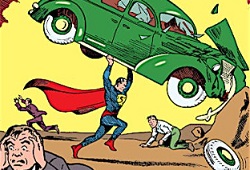
Cover art by Joe Shuster
According to historian William E. Leuchtenburg in his 1963 book Franklin D. Roosevelt and the New Deal, the aftershocks of the Stock Market Crash of 1929 were quickly felt across the country. Industrial production was cut in half by 1932, for instance, and the number of unemployed stood at over thirteen million. Evicted coal mining families in Kentucky and West Virginia were forced to shelter in tents during the winter months, while the homeless in larger cities lived in shacks made out of cardboard boxes and scrap metal. Others protected themselves from the elements in discarded automobiles left to rust in junkyards.
While President Herbert Hoover seemed unable to stem the tide of the Great Depression, presidential candidate Franklin Delano Roosevelt announced at the Democratic National Convention in 1932, “I pledge you, I pledge myself, to a new deal for the American people.” The words became symbolic of Roosevelt’s later expansion of the federal government in an effort to help “the forgotten man at the bottom of the economic pyramid.”
It was this “forgotten man” of Franklin Roosevelt’s New Deal that was on the minds of two Cleveland teenagers – Jerry Siegel and Joe Shuster – when they initially conceived the world’s first comic book superhero, Superman, over the summer of 1933.
“We thought of the idea during the Depression,” Siegel told the Chicago Sun-Times decades later. “We were just out of Glenville High School in Cleveland, and I would listen to President Roosevelt’s fireside chats on the radio, and I sensed the hopelessness and fear in the country. I wondered if there was a way to help the despairing masses, somehow. But what could I do to help them, when I could barely help myself? Superman was the answer.”
The superhero’s initial appearance in Action Comics #1 begins with a brief overview of his origin story before telling readers, “Early, Clark decided he must turn his titanic strength into channels that would benefit mankind. And so was created Superman! Champion of the oppressed, the physical marvel who had sworn to devote his existence to helping those in need.” On the pages that follow, the newly minted defender of everyday Americans exonerates an innocent man convicted of murderer, intervenes to stop a husband’s domestic assault against his wife, and uncovers corruption within the halls of Congress.
During the first one hundred days of Franklin Roosevelt’s presidency, he didn’t have to contend with a corrupt Congress but one that was willing to approve what William Leuchtenburg referred to as “the most extraordinary series of reforms in the nation’s history,” which, taken together, “accepted responsibility for the welfare of millions of unemployed: pledged billions of dollars to save homes and farms from disclosure; undertaken huge public works spending; guaranteed the small bank deposits of the country; and had, for the first time, established federal regulations on Wall Street.”
It wasn’t long before Superman was duplicating the New Deal within the pages of Action Comics. One of the bills passed by Congress in 1933 was the Guffey-Snyder Act, which classified coal as a public utility and thus subject to federal regulation. It also granted coal miners the right to collective bargaining, established uniform scales of wages and hours, and instituted a production tax to help rehabilitate displaced workers. When the U.S. Supreme Court later found the unified wages and hours clause to be unconstitutional, the remaining provisions were reestablished under the Guffey-Vinson Act of 1937.
In Action Comics #3, Superman heads to Blakelytown, where a coal miner is trapped underground after a cave-in. A rescue crew is sent in but when contact is lost shortly afterwards, the superhero – posing as a miner – intentionally loses his balance and plummets down the shaft. Upon discovering that the crew has been knocked unconscious by a poisonous gas, he sends them back to the surface and then tracks down the missing miner, rescuing him as well.
Superman later visits the miner in the hospital as newspaper reporter Clark Kent. “Months ago, we know the mine is unsafe,” he is told. “But when we tell boss’s foreman they say, ‘No like job, Stanislaw? Quit!’ But we no quit. Got wife, kids, bills. So back we go to mine an long hours and little pay… an maybe to die.”
When Kent confronts mine owner Thornton Blakely about Stanislaw Kober’s accusations, Blakely replies, “There are no safety hazards in my mine. But if there were, what of it? I’m a businessman, not a humanitarian.” When Superman later lures Blakely and his aristocratic friends into the mine and fakes a cave in, the owner has a change of heart. “You can announce that henceforth my mine will be the safest in the country, and my employees the best treated,” he now tells Clark Kent. “My experience in the mine brought their problems closer to my understanding.”
When a subway train crashes and dozens are injured in Action Comics #14, meanwhile, Superman discovers that the subway walls were constructed of inferior material. He’s not the only one searching for answers, however, as someone else can be seen further down the tunnel. As Superman watches, two thugs appear and knock the man unconscious, then leave him on the tracks as a subway train quickly approaches. Superman is able to reach the man at the last second, then outraces the train to the platform.
“I’m City Inspector Hughes,” he is told afterwards. “I was suspicious of th’ building material used by the Star Company, which constructed the subway. Those men who attacked me trailed me to the spot.”
Superman tracks down the two thugs and eavesdrops on their conversation with the owner of the Star Company, a man named Lyons. As they talk, the owner gets a phone call informing him that City Inspector Hughes has registered a complaint against his company. Confused by how Hughes survived the oncoming train, the answer suddenly appears in the form of Superman. The Man of Steel then dangles Lyons out a window until he confesses that he used cheap material in the construction of the subway in order to line his own pockets.
The “forgotten man” of DC Comics was even more expansive than the New Deal of Franklin Roosevelt. In Action Comics #7, for instance, Clark Kent interviews the owner of Jordan Circus, only to discover that the man is on the verge of bankruptcy. In order to get more people to attend the circus, Superman volunteers as the new strongman and turns the struggling enterprise into an overnight success. When a loan shark who hoped to take ownership of the circus now resorts to sabotage, the superhero again saves the day.
The anonymous tipster that Clark Kent meets in Action Comics #10, meanwhile, turns out to be an escaped convict with welts on his back. When asked where he got them, the man replies, “Under the whip-lash at the Coreytown chain gang. But this is only one of the horrors we prisoners suffer – starvation, the sweat-box, living like cattle.” He then tells Kent, “I want you to tell your readers all about the rotten conditions at Coreytown chain gang so that public opinion will force a reform.”
Realizing that more than words in a newspaper are required, Clark Kent travels to Coreytown in disguise, gets arrested and is sent to the facility, where he takes down the camp’s superintendent from the inside.
“This great Nation will endure as it has endured, will revive and will prosper,” Franklin D. Roosevelt declared at his presidential inauguration. “So, first of all, let me assert my firm belief that the only thing we have to fear is fear itself – nameless, unreasoning, unjustified terror which paralyzes needed efforts to convert retreat into advance.”
While Roosevelt’s leadership and his New Deal helped to eradicate that fear in the real world, within the fictional realm of comic books another champion emerged to fight for the “forgotten man.”
“Friend of the helpless and oppressed is Superman, a man possessing the strength of a dozen Samsons!” the opening panel of Action Comics #7 states. “Lifting and rending giant weights, vaulting over skyscrapers, racing a bullet, possessing a skin impenetrable to even steel, are his physical assets used in his one-man battle against evil and injustice!”
As the residents of Metropolis quickly discovered, there was nothing to fear as long as Superman was around.
Anthony Letizia