

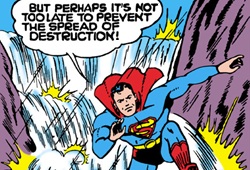
Art by Wayne Boring
On the opening pages of World’s Best Comics #1, B. Drexel Rutherford, chairman of Rutherford Utilities, is visited by a strange man who tells him that it is going to rain in five minutes. When the precipitation arrives as predicted, Rutherford brushes it off as nothing more than coincidence. “Co-incidence, did you say?” the man replies. “May I disagree! I knew the rain was coming because I commanded it to. You see, Mr. Rutherford, I have learned how to govern rainfall – and unless you pay me well, I’ll see to it that your dam in Imperial Valley is destroyed!”
America may be considered a land of plenty, but not necessarily when it comes to rain. Droughts often devastated large swaths of the country during the nineteenth century, from Kansas all the way to California. As a result, the need for rain inevitably gave rise to a “part snake-oil salesman, part pseudoscientist” called the rainmaker, who claimed to have the ability to control the weather. Considering the impact that the lack of precipitation had on crops, it should be no surprise that there were plenty of desperate farmers willing to hire them.
In 1902, a young man named Charles Hatfield came up with his own concoction of chemicals designed to make it rain, and it wasn’t long before he was conjuring clouds on his father’s olive ranch in Southern California. While most rainmakers had given up the craft by then, Hatfield embarked on a career that found remarkable success – or, depending on one’s point of view, he was phenomenal lucky at being at the right place, at the right time – with San Diego being the most infamous.
According to Garry Jenkins in his 2005 biography The Wizard of Sun City: The Strange True Story of Charles Hatfield, the Rainmaker Who Drowned a City’s Dreams, the Southern California city was continuously in need of fresh water, one of the few negatives of living in the land of sunshine. San Diego operated a number of dams to help alleviate the problem but experienced a drought in 1915 that drastically dwindled the available water supply. By December, the city council was desperate and turned to Charles Hatfield.
Back in Metropolis, the Rainmaker is aware that Drexel Rutherford is still skeptical of his abilities. He thus duplicates his original feat by making it rain at a Drexel Utilities employee outing, as well brewing up a storm on a nearby lake that causes a company executive to fall off his yacht and drown. Since Rutherford still refuses to capitulate to his demands, the Rainmaker sets his house on fire – fortunately Superman is nearby and rescues the businessman and his wife. Afterwards, Rutherford tells Daily Planet reporter Clark Kent of the Rainmaker’s demands.
Kent informs his editor Perry White about the allegations and immediately takes off as Superman to Imperial Valley, unaware that White has also assigned Lois Lane to cover the story. The Man of Steel spots an explosion near the dam upon his arrival and is confronted by the Rainmaker’s goons when he goes to investigate. They first warn him off with words, then with guns, neither of which have an effect. Closer to the villain’s lair, Superman is attacked by a boa constrictor serving as guard dog and more goons with guns, again to no avail.
The Rainmaker is another matter. He fires a futuristic weapon at Superman that releases a green-colored gas which immediately renders the Man of Steel helpless. “You musn’t destroy that dam,” Superman can only plead as the Rainmaker activates his rainmaking device. “Hundreds of farmers in the valley will have their property ruined. Many will die.”
Charles Hatfield pitched three offers to San Diego’s city council, including the one ultimately accepted – “To fill Morena Reservoir to overflowing between now and December 20, 1916, for the sum of $10,000.” The agreement was verbal, however, and no written contract between the city and Hatfield was ever signed. The rainmaker believed it was a “good faith” pact nonetheless, and on January 1, 1916, set up camp on the northern slopes of Lake Morena, including the observation tower that Hatfield used to unleash his secret rainmaking formula.
Seven-tenths of an inch of rain fell on Monday, January 10, followed by two days of sunshine. It again rained on Thursday, only this time it didn’t let up. By Sunday, over 153 million gallons of water – from rain and river runoffs – had been added to the city’s water supply, with 119 million of those gallons in Morena Reservoir. On Monday, January 17 – the fifth straight day of rain – the rivers in Mission Valley overflowed. The Santa Fe railroad line was underwater and homes were seen floating away due to the flooding. Canoes were even used downtown to ferry those stranded by the water to safety.
After another week of rain, the Morena Reservoir was filled with ten billion gallons of water for the first time in its brief existence. Charles Hatfield had succeeded in achieving the impossible in an unbelievably short period of time. Unfortunately, the rain wasn’t ready to stop, and the Lower Otay Dam burst three days later.
Only one of the twenty-four houses in Otay Valley survived the onslaught. There were numerous deaths, and $3.7 million dollars’ worth of damage. Hatfield was oblivious to all the destruction until he finally made his way down from the northern slopes of Lake Morena to collect his $10,000 paycheck. Instead of being hailed as a conquering hero, he was treated as a villain and had to hide his identity during his journey to downtown San Diego.
As the rain continues to pour down in Imperial Valley, Superman is finally able to regain control of his body. While the Rainmaker shouts, “More rain! More! I’ll wipe that dam off the face of the Earth,” the superhero pushes the villain’s cabin off a cliff and into a raging river. The dam, however, bursts from the built-up pressure just as the Man of Steel arrives at the scene. He races ahead of the rushing water to a mountain, where he quickly digs a large pit and uses a giant boulder to redirect the resulting flood into an uninhabited desert.
Superman has no chance to rest as the plane carrying Lois Lane from Metropolis is caught in the still raging storm. Seconds before the craft crashes, he leaps underneath it and softens the landing. The Rainmaker makes one last appearance at that point, threatening to kill the female reporter. Superman stops the resulting bullet mid-air then chases after the villain, who trips and smashes his head against a rock, killing him instantly. While Lois Lane is ecstatic about being rescued by Superman once again, she is aghast to discover afterwards that Clark Kent filed the story with the Daily Planet before she had a chance to herself.
Rain, floods, and unpredictable weather patterns are legally considered “acts of God,” and the city of San Diego could therefore not be held accountable for all the death and destruction that occurred in January 1916. If the city council actually paid Charles Hatfield for his services as a rainmaker, however, blame – as well as legal liability – could potentially fall on them, something council members were dead set against. They thus refused to honor their verbal agreement. A written contract was instead offered to Hatfield after the fact that called for the rainmaker to assume all legal liabilities in exchange for his $10,000 payment. He declined to sign the document.
Despite the setback, Charles Hatfield continued to make a living as a rainmaker until the Great Depression and building of the Boulder Dam – which diverted the Colorado River and supplied water to Southern California – inevitably ended his career. Nonetheless, he remained adamant throughout his life that the city of San Diego still owed him $10,000, declaring, “The rain of 1916 was an act of Hatfield, not an act of God.”
Anthony Letizia