

While most educators who believe popular culture can be used as an educational tool likewise consider it to be a secondary source – having been created by “observers” of a given time period as opposed to active participants – Mercer University professor Andrew Grunzke has a different viewpoint, arguing that it can be used as a primary source as well.
“In the interests of providing a specific example, teachers of history are more concerned about getting students to critique the historical accuracy of the miniseries Roots (1977) with respect to what it teaches its audience about slavery by comparing it to other secondary histories their students are reading than encouraging them to look at Roots as a primary text about how Americans in the 1970s thought about race relations,” he wrote in Educating Through Popular Culture: You’re Not Cool Just Because You Teach with Comics, a collection of essays by various educators published in 2017.
While Grunzke discusses a wide-range of popular media by way of introduction, his specific contribution – “Using Multimedia Literacy to Teach Gender History through Comic Books” – specifically focusses on Wonder Woman comic books. Even here, Grunzke digresses from the norm, bypassing the actual adventures of the superhero and concentrating instead on two supplemental features of Wonder Woman that likewise appeared in the comic book, Wonder Women of History and Marriage à la Mode.
Wonder Woman creator William Marston – a psychologist of some notoriety – had a not-so-secret agenda of promoting both women and women’s rights within the narratives that he wrote during the 1940s. Initially hiding his involvement through the alias Charles Moulton, Marston sent out a press release announcing himself as the character’s creator, as well as making his agenda public, when Wonder Woman was given her own comic book in 1942 to go along with her headlining of Sensation Comics.
“‘Wonder Woman’ was conceived by Dr. Marston to set up a standard among children and young people of strong, free, courageous womanhood; and to combat the idea that women are inferior to men, and to inspire girls to self-confidence and achievement in athletics, occupations and professions monopolized by men,” historian Jill Lepore quotes the release as saying in her 2014 book The Secret History of Wonder Woman.
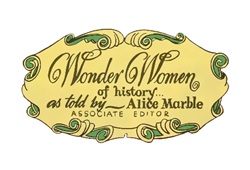
Around that same time, Alice Marble – who won eighteen Grand Slam tennis championships during the 1930s – met publisher Max Gaines at a cocktail party after her retirement and asked, “Why don’t you do real-life wonder women, the women who have made history?” Gaines hired Marble afterwards as an associate editor and put her in charge of a Wonder Women of History supplement to Wonder Woman comics, beginning with issue number one.
As David M. Kennedy writes in his 1999 book Freedom from Fear: The American People in Depression and War, 1929-1945, nearly twelve million women were employed in the United States before Japan attacked Pearl Harbor in December 1941. While a high percentage were African Americans employed as domestic servants, white women were also part of the workforce, primarily as teachers, nurses, social workers, or civil servants. Their employment only lasted a few years, however, as they subsequently left their jobs upon getting married.
World War II inevitably changed that fact – even with an initial limited draft into the armed forces for men, industrial factories quickly found themselves short on labor. Rosie the Riveter was thus born, a mythical tool-wielding, denim-clad creation declaring “We Can Do It” and enticing six million previously stay-at-home wives to enter the workforce. Two million women worked in defense plants during the war, one half million in aircraft factories, and nearly a quarter million in shipbuilding.
In May 1942, meanwhile, President Franklin Roosevelt created the Women’s Army Auxiliary Corps – shortened to Women’s Army Corps the following year, or simply WACSs – which was followed by the Navy’s Women Accepted for Voluntary Emergence Service (WAVES), and the Air Corps’ Women’s Auxiliary Emergency Service (WASPS). At total of 350,000 women enlisted in the armed forces in noncombatant positions as a result. Add in those who volunteered with the Red Cross or entertained troops at reception centers, and the number of women who assisted on the home front was close to nineteen million.
Each Wonder Women of History narrative – which premiered over the summer of 1942 and coincided with an expanded role for women during World War II – ran from one to four pages in length and spotlighted a real-world woman of significance. Wonder Woman #1, for instance, highlighted Florence Nightengale, while Wonder Woman #5 contained a four-page biography of Susan B. Anthony. Other factual women who shared the pages of Wonder Woman include Clara Barton, Joan of Arc, Helen Keller, Annie Oakley, Amelia Earhart, Dolly Madison, and Nellie Bly.
“‘Wonder Women of History’ was, in many respects, part of the educational push of the comic and sought to give readers, particularly young, female readers, knowledge of the contributions women had made in world history,” Andrew Grunzke writes in Educating Through Popular Culture. “In the end, the comic’s authors were promoting an educational agenda that differed substantially from that of the public school. For many students, ‘Wonder Women of History’ was their first exposure to women’s history. Even if it wasn’t, it was directed at seriously different social aims than the sort of women’s history they were getting in school.”
The final Wonder Women of History appeared in Wonder Woman #66, published in March 1954. As Grunzke notes, Fredric Wertham’s Seduction of the Innocent was published the year before. An attack against the comic book industry in general, Wonder Woman was specifically singled out for giving young girls the “wrong ideas” about a woman’s place in the world. Seduction of the Innocent caused an uproar in the United States, resulting in the creation of a Comic Code Authority to ensure safer narratives for the youth of America.
Presumably as a result, Wonder Women of History was replaced within the pages of Wonder Woman with Marriage à la Mode, a one-page feature that spotlighted marriage customs from around the world, including China, Germany, Ireland, Japan, Korea, and Syria. In addition to premiering the year after Seduction of the Innocent was published, the supplement also appeared at a time when cultural norms were once again shifting within the United States.
After World War II ended and American men returned home to rejoin the workforce, women were inevitably pushed to the wayside and into the more “traditional” roles of girlfriend, wife, mother, and homemaker. According to Terry Anderson in his 1995 book The Movement and the Sixties, women who wanted a career as well as a homelife were thus deemed a “menace” to society who needed to be “stopped” as a result. Four male doctors in a 1956 issue of Life magazine even claimed that a woman’s desire for more than culturally acceptable was a “disease” that could result in a family’s children becoming juvenile delinquents, atheists, Communists, and homosexuals.
In addition to the switch from Wonder Women of History to Marriage à la Mode, the actual narratives contained within Wonder Woman and Sensation Comics changed from one decade to the next as well. William Marston – who died in 1947 – wrote empowering stories of womanhood for his female creation, including one in which women workers were suspected of sabotaging weapon factories and another containing an assassination attempt against an Army general during an inspection of the Women’s Army Auxiliary Corps training facility.
In both instances, Wonder Woman proved events were orchestrated by outsiders intent on discrediting the value of women during the war. By the time the 1950s rolled around, however, alter-ego Diana Prince was more interested in her romantic relationship with Steve Trevor than standing up for women’s rights.
As Andrew Grunzke concludes in Educating Through Popular Culture, “By having students study the ‘Wonder Women of History’ and ‘Marriage à la Mode’ segments within the context of the larger comics and the educational and social histories of the two eras in which they were published, the history teacher has an opportunity to sharpen students multimodal literacy skills while using comics as primary historical documents to illustrate the shifting gender attitudes of the American postwar.”
Such an approach also demonstrates the slow shift to using comic books as primary sources as opposed to secondary. “Holy Hera!” indeed.
Anthony Letizia