

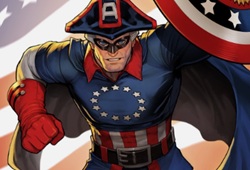
Variant cover art by David Nakayama
In the New York City of the Marvel Comics Universe, Captain America, Iron Man, Spider-Man, and Bruce Banner – aka the Hulk – are summoned to the Sanctum Sanctorum of Doctor Stephen Strange. The powerful sorceress Morgan Le Fay has traveled to the year 1777 and hatched a plan that would not only bring an end to the Avengers but the entire United States. When Captain America asks how, Doctor Strange simply replies, “By making sure that the British, not the Continental Army, win the war of the America rebellion.”
With the year 2026 being the 250th anniversary of that rebellion, Marvel Comics released a special five-issue miniseries entitled 1776 that witnessed the above-mentioned superheroes – with the exception of Stephen Strange, who sends the Sorceress Supreme of the Dark Dimension, Clea, in his place – going back in time to thwart Le Fay’s plans. Along the way, they meet American generals Benedict Arnold and Horatio Gates, as well as founding father Benjamin Franklin.
Tony Stark – Iron Man – initially gets that latter honor, sent by Captain America to Philadelphia to warn the Continental Congress that the British are coming and they need to evacuate. Stark not only finds an ally in Franklin but one who deduces that he is from the future.
It is one the few plot points where 1776 writer J. Michael Straczynski strays from factual history. According to Rick Atkinson in his 2025 book The Fate of the Day: The War for America, Fort Ticonderoga to Charleston, 1777-1780, Benjamin Franklin was actually in Paris at the time, trying to convince France to recognize the United States and sign a commercial trade agreement with the fledging nation. A treaty between the two countries was eventually signed on February 6, 1778, with the American victory against the British in Saratoga, New York, being one of the key factors for France agreeing to an alliance.
It is the outcoming of that battle that Morgan Le Fay intends to change when she offers her supernatural services to British Lieutenant General John Burgoyne. Burgoyne originally planned to assemble an army in Canada, cross the border and capture the rebel fort at Ticonderoga. From there, he would push on to Albany and join forces with General William Howe, currently in New York City. Having secured a swath of land running from Canada to Manhattan as a result, the British would have separated the New England colonies from their compatriots in the south, splintering the rebellion in the process.
Although those plans were disrupted when General Howe decided to advance on Philadelphia instead, Burgoyne was undeterred. First, he seized Fort Ticonderoga by default – the colonialists were outnumbered and Major General Arthur St. Clair retreated rather than risk capture. From there, Burgoyne continued to Fort Edward, where the rebels were again forced to scatter. The remains of St. Clair’s men eventually made their way to Saratoga, where they were joined by Major General Benedict Arnold. It wasn’t long before the colonial forces – now under the command of Major General Horatio Gates – were further replenished with new troops from New England, Pennsylvania, and Virginia.
The Marvel superheroes arrive in Saratoga on September 16, 1777, three days before the first confrontation between British and American troops. Everyone is given their assignments, with Captain America and Spider-Man heading to the rebel camp. Throughout the narrative, Captain America occasionally takes on the role of “history teacher” for both Spider-Man and those readers who might be less familiar with the American Revolution.
When Spider-Man notices Black soldiers in the Continental Army, for instance, Cap tells him, “Some were slaves promised freedom if they took part in the fight. Others were free men who believed in the cause, like Peter Salem, who became something of a legend. He started as a minuteman, fought at the Battles of Lexington and Concord. And then there was the incident at Bunker Hill.”
British Major John Pitcairn, who was respected and feared by both sides of the conflict, led one of the charges up Bunker Hill on June 17, 1775. “When he stood up that day, framed against the sun, drew his sword and yelled out, loud enough to be heard over the gunfire and chaos, everybody just kind of froze,” Captain America continues. “With one exception. The loss of Pitcairn in battle showed that the British were vulnerable – it improved America morale and turned the tide of the war, at least for a while.” The “one exception” was Peter Salem, who many of the rebels present that day claimed was responsible for Pitcairn’s death.
As for Benedict Arnold being “different” than Spider-Man had expected, Captain America explains, “We’re all different people at different times, just one decision away from making a terrible mistake. Right now, he’s highly regarded by everyone in the Continental Army.” That regard, however, was not reciprocated by Arnold. “He began to resent the generals dismissing his opinions, looking on as officers he considered less qualified were promoted ahead of him. And his pursuit of the war left him heavily in debit. So he made that one decision, became that different person, and, in return for promises of money, power, and prestige, sold out his country and every soldier under his command.”
On September 19, 1777, the first Battle of Saratoga erupted and lasted for close to seven hours. The battlefield changed hands up to six times and more-or-less ended in a stalemate, although the rebels were the clear winners of the day, having prevented the British from breaking through their defenses and suffering half as many casualties than their counterparts. When nightfall arrived, Burgoyne gathered his exhausted troops and waited for reinforcements that would never arrive.
The same did not hold true for the colonialists, who soon had twelve thousand men – twice the number of redcoats still able to fight – located a mere mile south of the British camp with another group slightly north, cutting off the enemy’s potential retreat to Fort Ticonderoga. With supplies running out and winter on its way, General Burgoyne made one last attempt on October 7 to break through the rebel’s left flank. Instead of playing it safe, Benedict Arnold convinced Horatio Gates to go on the offensive. By 5 p.m., the second Battle of Saratoga, with a quarter of the British forces lying dead in a field and the remainder on the run, was effectively over. Five days later, Burgoyne began negotiating terms of his surrender with Gates.
While racing on horseback to the Battle of Saratoga within the Marvel Comics Universe, Captain America offers his thoughts on the American Revolution to Spider-Man. “The Founding Fathers were human, with all the glories and flaws of the human race,” he begins. “Some owned slaves, others were scoundrels, deadbeats and misanthropes. Others drank too much and thought too little. But they believed in something bigger than they were. They didn’t make it about themselves. It was about crawling out from under royalist tyranny to create something new – a place where the people could decide how they were to be governed.”
He then adds, “Exhausted after pulling a new nation across the finish line, they created a foundation for what was to come afterward, knowing they were handing over an incomplete process. A way of saying, ‘We took this as far as we could, given who we were, the tools we had, the flaws we owned, and the time in which we lived. Pick up where we left off. Do better. Carry the light forward. Make the ‘more perfect union’ we promised a reality.”
A fitting epitaph of the past as well as message for the present, spoken by the Marvel Comics personification of the ideals on which the country was founded.
Anthony Letizia
Explore more Comics and History: The American Revolution on Remixing History