

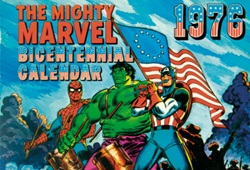
Cover art by John Romita Sr.
During the 1780s, artist John Trumbull – who briefly served as an aide-de-camp to General George Washington in 1775 – remarked to Thomas Jefferson while both were in Paris that he intended to create a series of paintings on key battles from the American Revolution. Jefferson liked the idea but suggested that the Declaration of Independence should be included as well.
Although most people believe the resulting artwork – which is currently displayed in the Rotunda of the U.S. Capitol – depicts the signing of the Declaration of Independence, it in fact shows the drafting committee submitting their proposal to the Continental Congress. In his 2025 book The Year That Made America: From Rebellion to Independence, 1775–1776, Tom McMillan quotes a Capitol historian who once explained that Trumbull “decided not to attempt a wholly accurate rendering of the scene; rather, he made his goal the preservation of the Nation’s founders.”
Like Thomas Jefferson, Marvel Comics publisher Stan Lee likewise made a “suggestion” to his editor Roy Thomas that the company’s 1976 calendar contain an American Bicentennial theme, with images from the American Revolution depicted each month. As with Trumbull, the illustrations were not “wholly accurate” but contained characters from the Marvel Universe interacting with factual historical figures. Thus just as Trumbull’s Declaration of Independence – as well as over a dozen of his other paintings – tell the story of the American Revolution in pictures, the same can be said of The Mighty Marvel Bicentennial Calendar and its illustrations.
While most of the images are easy to recognize, others are more obscure. On June 28, 1776, for instance, four hundred colonials successfully defended Fort Sullivan in South Carolina against nine British Royal Navy warships under the command of Commodor Sir Peter Parker. A depiction of the Marvel Universe’s Peter Parker catching cannonballs in his Spider-Man webbing and hurling them back out to sea is the featured artwork for June in The Mighty Marvel Bicentennial Calendar.
According to John E. Ferling in his 2007 book Almost a Miracle: The American Victory in the War of Independence, Congress named Esek Hopkins – a veteran sea captain and the brother of a Rhode Island congressman – as commander in chief of the navy in December 1775. When later ordered to safeguard the American coastline, Hopkins instead sailed to the Bahamas. With eight ships, 230 marines, and 50 sailors under his command, he arrived at New Providence Island in March 1776, forced two British forts to surrender, and confiscated seventy-eight cannons, fifteen mortars, sixteen thousand shells and cannon balls, and twenty barrels of powder.
The Marvel Comics World War II-era Invaders – consisting of Captain America, Bucky Barnes, Namor the Sub-Mariner, and the original Human Torch and his sidekick Toro – can be seen during the month of January as part of Commodore Hopkins’s crew.
With acts of rebellion increasing in 1775, King George III decided it was time to go on the offensive. The British commander-in-chief in North America, General Thomas Gage, was thus authorized to use whatever force deemed necessary to put an end to the growing unrest, as well as seize those responsible. On April 19, Gage ordered soldiers stationed in Boston to arrest Samuel Adams and John Hancock in nearby Lexington, then proceed to Concord to destroy an arsenal of rebel weapons stashed there.
Fortunately, the colonialists received word ahead of time and Paul Revere made his famous midnight ride to warn both towns that the British were coming. During a standoff between sixty members of the Lexington militia and a British advance party, a lone rifle shot echoed through the night. No one knows who fired the shot or why, but for approximately thirty seconds a skirmish – as well as revolution – erupted. Once order was restored, the British sent a larger force to Concord.
Not only were members of the town’s militia ready but hundreds of nearby “minutemen” from throughout Massachusetts as well. As a result, the British were vastly outnumbered by the time they reached the North Bridge. Twelve redcoats were wounded during the subsequent battle, three of them fatally. Once the shooting ended, Lieutenant Colonel Francis Smith led his troops back to Boston, giving the colonialists an early victory in a war that would last for years. According to the illustration created for The Mighty Marvel Bicentennial Calendar, Conan the Barbarian was amongst the minutemen who fought that day.
Valley Forge wasn’t George Washington’s first choice to rest his troops during the winter months of 1778. He initially wanted to spread them out in small camps across Pennsylvania. Some of his officers, meanwhile, preferred Wilmington, Delaware. As for the Continental Congress, they believed that instead of the customary winter break from the war, Washington should continue his military campaign against the British. Since no one was in agreement, Valley Forge was chosen as a compromise.
Despite the myths about Valley Forge, John Ferling explains in Almost a Miracle that the weather was actually milder than normal. That meant more rain than snow, however, turning unpaved roads into mud, while any drop in temperature froze the river. Getting supplies was therefore difficult, especially food. The area had also been the site of a previous battle, during which both sides picked the region clean. Farmers, meanwhile – both locally and in New England – were often reluctant to sell their produce to the Continental Army, knowing that the British would pay more. Even when food was acquired, it was often hijacked by the redcoats before it reached its destination.
By March 1778, over eleven hundred soldiers had deserted to nearby Philadelphia. Another 2,500 had died, as had most of the horses. Word soon reached British General William Howe that Washington’s men were “sickly and destitute of Cloathing, without Medicine, without Salt or Salt Meat.” Although an ideal opportunity to squash the rebellion once-and-for-all, Howe declined to attack Valley Forge, spending his remaining time as commander-in-chief within the safe confines of Philadelphia. As for the Hulk, he can be seen stomping through the heavy snow of Valley Forge during the month of February.
After having suffered defeat in New York City at the hands of the British and then forced to retreat through New Jersey to Pennsylvania, General George Washington was eager for a victory to close out 1776. His counterpart General Howe had taken the opposite approach, setting up winter camps for his army in eastern New Jersey. The town of Trenton, located on the bank of the Delaware River, was handed over to German Hessians. Acting on their own accord, members of the New Jersey and Pennsylvania militia began waging a guerilla war against their foreign occupiers.
Hoping to take advantage of the unrest, George Washington and his men crossed the Delaware River on the night of December 25, 1776, under less-than-ideal circumstances. The temperature slightly warmed at nightfall, leading to rain and then hail and finally snow as it again dropped. The winds picked up as well while huge chunks of ice floated in the churning waters.
Washington and his men were three hours behind schedule by the time they made it across the Delaware but the resulting battle against the Hessians was short and decisive. Although the victory wasn’t pivotal from a strategic standpoint, it boosted morale and helped recruitment efforts to build a larger Continental Army. It also served as the inspiration for one of the most iconic images of the American Revolution – Emanuel Leutze’s 1851 oil painting Washington Crossing the Delaware.
The German American Leutze hoped to capture the unity of the war effort by depicting a cross-section of Americans in the painting, including a Delaware soldier, Scottish Highlander, and African American rower. The scene is duplicated for December in The Mighty Marvel Bicentennial Calendar, with Captain America, Hawkeye, Scarlet Witch, and Vision standing next to George Washington while Iron Man and Thor fly overhead.
Neither the original painting nor the superhero recreation is historically accurate, but each commemorates an inspirational moment from a war that gave birth to the United States of America nonetheless – as well as the ideals on which the country was founded.
Anthony Letizia
Explore more Comics and History: The American Revolution on Remixing History