

By Frederic Krome
Science fiction author Ken MacLeod once remarked, “History is the trade secret of science fiction, and theories of history are its invisible engine.” Thus while science fiction is generally considered to be futuristic, the majority of its narratives are reflections of both the present and the past, not only offering insights into a particular period of time but likewise acting as historical artifacts that shed light on that period.
For these reasons, University of Cincinnati professor Frederic Krome considers science fiction to be the perfect supplement to the history classroom. “At the postsecondary level, especially for us teaching at an open-access college with a large proportion of underprepared students, finding material that can excite a student’s curiosity can be key toward greater student engagement,” he writes in his 2024 book New Approaches in Teaching History: Using Science Fiction to Introduce Students to New Vistas in Historical Thought. “Most importantly, when dealing with students at any level who are taking history as a requirement rather than from interest, the discovery that they can read a science fiction story or watch a science fiction film as part of their classwork often comes as a pleasant surprise.”
In New Approaches in Teaching History, Krome demonstrates the various ways that science fiction classics can be used to teach different aspects of history, such as Jules Verne and nineteenth century nationalism and imperialism, Philip Frances Nowlan’s Armageddon 2419 A.D. – featuring the first appearance of Buck Rogers – and anxieties over technological advancements, Frank Herbert’s Dune and the environment, and Afrofuturism and its connection to African American history.
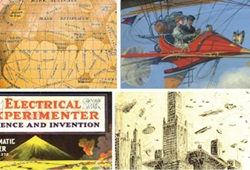
The years between the late 1930s and mid-1950s are often considered the “Golden Age of Science Fiction,” and two chapters in New Approaches in Teaching History specifically pertain to the time period – “Science Fiction and the Holocaust” and “Mutations and Monsters: Cold War Anxieties in the 1950s and ’60s.” In the former, Frederic Krome notes that “one of the most fascinating sources for stories” on the rise of Nazism during the 1930s are the old pulp magazines whose popularity were at their peak during the decade.
American Jewish author Nat Schachner, for instance, wrote over fifty short stories that were published in pulps at the time, including “Ancestral Voices,” considered by historian Paul Carter as the “first shot in pulp science fiction’s ragged but earnest crusade against Hitler and fascism.” Schachner’s narrative contains of a series of vignettes featuring racially stereotyped characters (including an American Jewish boxer facing off against a German counterpart) juxtaposed against the story of a mad scientist who invents a time machine. During his travels to the fifth century, the scientist kills a barbarian invader who shares similarities to Attila the Hun. It turns out that the mad scientist is not only a descendent of the barbarian but the people who appeared in the short vignettes are as well, all of whom vanish from existence after he is killed.
“Schachner’s goal was not only to ridicule those who saw themselves as superior by dint of inheritance but also to challenge the very notion of racial decent,” Frederic Krome explains. “After all, the Jew and the German (boxers) both vanish because of the mad scientist’s actions.”
While pulp magazines dominated the science fiction landscape of the 1930s and ’40s, it was on the big screen that the genre most made its mark during the 1950s. The Thing from Another World, The Day the Earth Stood Still, and Godzilla are among the many classics produced during the decade, with each conveying the internal anxiety felt by a majority of Americans at the time regarding the Cold War between the United States and Soviet Union.
“Looking for science fiction sources to teach the popular culture of the Cold War era can easily overwhelm the instructor,” Frederic Krome writes in New Approaches in Teaching History. “Indeed, the sheer volume of material produced during the Cold War is matched only by the variety of subjects, ranging from alien invasions to postapocalyptic worlds.”
In regards to alien invasions, there are few more classic than Invasion of the Body Snatchers, in which the population of a small California town are being replaced by clone replicas – devoid of emotion or individuality – that are hatched from alien pods. An allegory for Cold War conformity during the age of McCarthyism, Krome likewise notes that the storyline can also be used as a metaphor for communism and life behind the Iron Curtain.
Any “top ten” list of best science fiction movies of the 1950s would likewise include Them!, in which the disappearance of a family in a New Mexico desert is attributed to a mutant colony of giant ants. The film doesn’t try to hide its Cold War roots – the ants’ existence is traced to the first atomic bomb explosion in a similar New Mexico desert, with the resulting radiation creating the creatures.
“When man entered the atomic age, he opened the door to a new world,” one of the main characters observes at the end of the film. “What we may eventually find in that new world, nobody can predict.”
Although many works of science fiction take place in a futuristic world, most authors depict their own world through a metaphoric lens. When analyzed decades later, these narratives act as a window to the past, a first-person account of the trials and tribulations of their times. The stories may be fictional but they connect to factual history nonetheless – which makes them the perfect teaching tool during the everchanging landscape of the twenty-first century.
Anthony Letizia
Explore more from the Education Library on Remixing History