

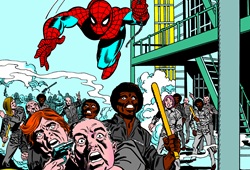
Cover art by Gil Kane and Artie Simek
On Monday, August 10, 1970, two hundred inmates at the Manhattan House of Detention for Men – colloquially known as the Tombs – seized control of the ninth floor of the facility and held five guards hostage until their list of grievances, which included overcrowding and guard brutality, were heard. The next day, an additional eight hundred prisoners rioted, seizing four of twelve floors and causing as much destruction as they could.
As Time noted in its August 24 edition, the uprising had long been in the making. “The 6-ft.-wide cells were designed for one man: now they often hold three, with one compelled to sleep on the concrete floor,” the magazine reported. “If a man gets a blanket, it is usually infested with lice and roaches.” Furthermore, most of the inmates had yet to be convicted of a crime and were merely awaiting trial.
The events at the Tombs were apparently on the mind of Marvel Comics editor-in-chief Stan Lee while working on The Amazing Spider-Man #99. Published in May 1971, the narrative includes the web-slinging superhero’s attempts to quell a prisoner riot at the city jail. Ironically, the issue was released just four months before the most infamous prison riot of the time period, an uprising at the Attica Correctional Facility state prison that resulted in the deaths of thirty-three inmates and ten correctional officers.
Within the Marvel Universe, photojournalist Peter Parker is assigned to cover the prison riot by the Daily Bugle. Since his new automatic sub-mini camera attaches easily enough to his Spider-Man costume, Parker arrives on the scene as the superhero. With the street below cordoned off by the police, Spider-Man heads to the roof, where he finds a pair of armed convicts standing guard. The webslinger grabs one of them, dangles him upside down, and asks what’s going on inside.
“We’re riotin’ to be treated like human bein’s,” the prisoner explains. “They keep us caged like animals. We gotta wait months to come to trial. We just want our rights, that’s all, and Turpo said he’d get ’em for us.”
After securing the convict to the roof, Spider-Man does something rarely attempted – he breaks into a prison rather than out. Realizing that he would hardly be welcomed by the inmates, he sneaks his way through the jail using the air ducts and overhears that Turpo, the con who organized the riot, is meeting with the warden. Spider-Man then heads towards the warden’s office, aware that the situation is dire but also sensing that the prisoner he interrogated on the roof was telling the truth.
“He really meant it about those gripes,” the superhero thinks to himself. “But where does the blame lie?”
In July 1971, a group of inmates at the Attica Correctional Facility in Attica, New York, submitted a petition to the state Commissioner of Corrections and Governor Nelson Rockefeller that contained a list of 27 demands for improving living conditions at the prison. There was no response. After a brief scuffle between inmates and guards during a recreation break on September 8, a full-scale riot erupted the next day, with inmates beating guards with pipes, chains, broomsticks, hammers, and baseball bats. They also seized control of the exercise yard and burned down the schoolhouse and chapel.
By the time the mayhem ended, thirty-eight guards had been taken hostage by the inmates. According to Rick Perlstein in his 2009 book Nixonland: The Rise of a President and the Fracturing of America, the list of demands included a reduction from the 2,250 inmates currently incarcerated at Attica to the 1,600 that the facility was designed to hold, more than one shower a week, and that the rule against “inmates congregating in large groups” not be used to forbid Muslim worship.
“We are men!” an inmate spokesperson told the media. “We are not beasts and we do not intend to be beaten or driven as such. The entire prison populace, that means every one of us here, has set forth to change forever the ruthless brutalization and disregard for the lives of the prisoners here and throughout the United States. What has happened here is but the sound before the fury of those who are oppressed. We will not compromise on any terms except those terms that are agreeable to us. We’ve called upon all the conscientious citizens of America to assist us in putting an end to this situation that threatens the lives of not only us but of every one of you, as well.”
Hovering outside the warden’s window, Spider-Man discovers that Turpo has actually instigated the riot as a diversion for a prison escape. When the other cons in the room realize what’s going on, an armed Turpo tells them, “I don’t care who I gotta ventilate to git outta here. After we’re gone, you guys can demonstrate all ya wanna. I just wanna thank ya fer bein’ our pigeons.”
On that note, Spider-Man crashes through the window and easily subdues Turpo and his accomplice. When the warden informs him that two more prisoners are standing guard outside, Spider-Man tosses Turpo at the door, knocking it down and causing all the convicts to run for cover. The webslinger tells them to hold up, that Turpo betrayed them. The cons are not convinced until one of the prisoners who was in the warden’s office confirms the news.
“But Turpo don’t mean nothin’,” he adds. “There’s something more important. The warden agrees with most’a our gripes. He said he’ll try’n help us.” Furthermore, the warden promised amnesty for everyone who participated in the riot if they immediately put down their weapons and return to their cells. Realizing they have nothing to lose, the prisoners consent.
“The riot is ended – for now,” the warden tells the journalists waiting outside. “But if we don’t get the money we need, the reforms we need, these prisons are gonna explode. And you can quote me!”
It didn’t take long before negotiations at the Attica Correctional Facility reached an impasse. While New York Commissioner of Corrections Russell Oswald agreed to twenty-eight of the inmates’ demands, he refused to grant amnesty for the inmates involved in the uprising or fire the Attica warden. Although Governor Nelson Rockefeller initially claimed that he had no constitutional authority to act, he authorized a rescue attempt and assault on the prison for September 13, 1971, nonetheless.
Unaware that a contingent of snipers and strike teams were positioning themselves outside the prison, the inmates decided to strengthen their hand by marching eight of the hostages – bound and blindfolded – onto an open walkway. Gunshots and the release of tear gas quickly followed, with many of the New York State Troopers firing indiscriminately. By the time it ended, ten prison guards and thirty-three inmates were dead. All but four had been killed by state troopers.
Having saved the day and secured exclusive photos from the riot for the Daily Bugle, Spider-Man is again swinging his way through New York City when he suddenly hears someone shouting his name through an open window. It turns out to be Johnny Carson, host of The Tonight Show, and he wants Spider-Man to be a guest on his program. “I just heard what happened at the prison,” Carson explains. “Think what a scoop it’ll be to have you on my show the very same night.”
That evening on The Tonight Show, Johnny Carson introduces his guest. After demonstrating his acrobatic skills to prove that he is the real Spider-Man, the superhero addresses the crowd. “Now that I’ve got a captive audience, I wanna talk about some other captives,” he begins. “I mean the prisoners who are locked-up in our understaffed, over-aged, over-crowded jails. I’m talking about conditions where young, first-offenders are put in the same cells with hardened criminals. About an antiquated system that makes prisons breeding grounds for crime. I’m talking about men who stay locked-up for months, waiting for trial, ’cause there aren’t enough judges, aren’t enough courts. Crime – and justice – are everyone’s problem. And it’s a problem that must be solved before it’s too late.”
The police arrive at that point to arrest Spider-Man on an outstanding warrant, bringing an end to the superhero’s appearance on The Tonight Show. Although his warning was delivered, it was indeed too late for the thirty-three inmates and ten correctional officers who died at Attica State.
Anthony Letizia
Explore more Comics and History: The 1960s and 1970s on Remixing History