

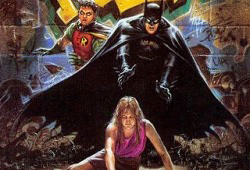
Cover art by Dave Dorman
In 1990, there were 2,245 murders in New York City. Thirty-three-year-old advertising executive John Reisenbach was one of those victims after making a late-night call from a pay phone outside his West Village apartment building on July 30. The building’s doorman told the New York Times that ten percent of the apartments were experiencing cable problems that evening, resulting in their phones not working.
“Another tenant used the pay phone five minutes before he did,” the doorman said. “It’s just one of those things that happens so quick and shocks.”
Instead of becoming another statistic of gun violence, the murder of John Reisenbach served as the catalyst for the nonprofit John A. Reisenbach Foundation – now known as Reisenbach Philanthropies – and its mission to build a safer New York, as well as a Batman comic book published in December 1992 that addressed gun violence in the United States that was likewise meant to “shock” the American populace.
John Reisenbach was the son of Sandy Reisenbach, an executive at Warner Bros., the company that owned DC Comics. DC president and editor-in-chief Jenette Kahn regular worked with Sandy Reisenbach and – along with her colleague Paul Levitz – attended John Reisenbach’s funeral.
“Paul and I left the service with grief so sharp we didn’t know where to put it,” she wrote on the back page of Batman: Seduction of the Gun. “Talking to one another, we felt the only release for the pain was to channel it into something positive. We resolved to publish a strong comic book story that would indict the proliferation of guns in this country and the ease with which they are used.”
Batman: Seduction of the Gun does indeed hit hard, a 64-page one-shot in which Batman and Police Commission James Gordon attempt to stop a guns-for-drugs deal between warring gangs in Gotham City. Throughout the narrative, the various reasons for an increase in gun violence during the late 1980s and early 1990s are explored, from video games and action films that glorified violence to a gun manufacturing industry intent on reaping high profits for the sale of their products.
“Denny O’Neil was the Batman editor back then and offered me the writing job, knowing I had once worked with an anti-gun organization,” John Ostrander explained on ComicMix in 2012. “Denny emphasized that we couldn’t just preach; first and foremost we had to tell a good story. We could make our points but they had to be part of the story. I had no problem with that; it’s one of the lessons I learned from studying Shakespeare – theme should be hardwired into the plot.”
Ostrander and artist Vince Giarrano spent several months researching gun dealers and street gangs for accuracy. In order to ensure that the “street lingo” sounded authentic, a copy of the script was given to seventh and eighth graders at a junior high school in Brooklyn. In his review of Batman: Seduction of the Gun, Memphis newspaper reporter Andrew Smith noted that the gunshot scenes were at “a level above what is normally acceptable in a mainstream DC book,” comparing them to an R-rated film.
“We wanted to show how ugly a gunshot wound is,” O’Neil explained. “It’s not antiseptic…. I’m not in the business of sensationalistic violence, but here it’s justified by the theme.” John Ostrander added, “The violence in the book is graphic and is intended to be so. It should be shocking, and it is, ugly and brutal. We don’t want to glamorize the violence.” As a result, Batman: Seduction of the Gun was not available at newsstands but exclusively at comic book shops and bookstores instead.
“There are no easy answers,” O’Neil emphasized. “But if kids grow up thinking about problems (like this), maybe someday they’ll come up with a creative solution.”
Within the pages of Batman: Seduction of the Gun, it is Tim Drake – aka the teenaged Robin – who is most contemplative about gun violence. “It’s just that… I don’t know… every time you see a gun in the movies or TV or in a comic book, it seems so easy, so clean, so neat,” he says at one point. “So cool. You lift it, you pull the trigger, the bad guy goes down. But you don’t use one, Bruce.”
“‘Guns don’t kill people,’ some will tell you,” Bruce Wayne replies. “‘People kill people.’ But I knew my father and later I met the man who killed him and I’ll tell you something. He never would have been able to kill my father without a gun.”
Commissioner James Gordon later meets with the president of a gun manufacturer, who offers a different viewpoint. “I’m not a villain,” he says. “This is a gun society. There is a demand that I supply. People want it. To paraphrase a competitor – God created man but guns made them all equal.”
During the main narrative, Batman disguises himself as a known gun dealer and meets with one of Gotham City’s gangs. “You still got those connections down in Virginia?” he is asked. “Chaka wants your butt down there and hook us up with some guns.” The mention of Virginia was not random as the state was considered the leading source for guns used in violent crimes along the East Coast.
“The fact that the state has achieved this notoriety in a comic-book strip should be an embarrassment to all Virginians,” a spokesperson for Governor L. Douglas Wilder told Patricia Davis of the L.A. Times-Washington Post News Service. “If the statistics and headlines don’t make the point, this comic book will.”
At the time, Wilder and the U.S. attorney for the Eastern District of Virginia were trying to push a legislation package through the state legislature that included a clause limiting the number of guns an individual could purchase to just one per month. After the publication of Batman: Seduction of the Gun, DC Comics reportedly agreed to provide free copies of the book to members of the Virginia General Assembly to help with the bill’s passage.
Although writer John Ostrander specifically selected Virginia for the location of the gun deal, he insisted it wasn’t meant to imply that Virginia was the only state with a gun control problem. The same held true for Virginia Beach, which already required criminal background checks for gun permits. “We’re the opposite of Gotham City,” Mayor Meyera E. Oberndorf explained, adding, “As a mother, and a mayor, I certainly can understand and sympathize with the mission that the magazine is about.”
The National Rifle Association unsurprisingly had a different viewpoint. Although there were parts of the anti-crime legislation promoted by Governor Wilder that the organization supported, it objected to both limits on handguns and the use of Batman: Seduction of the Gun to promote it. “I think there’s some confusion between fact and fantasy,” the Virginia liaison for the NRA told reporter Patricia Davis. “This is very serious legislation with very serious consequences to be using a comic book as a reference.”
At the end of Batman: Seduction of the Gun, Tim Drake asks Bruce Wayne, “So many guns, so much anger out there – how do you stop it?”
“It will end when we decide that it ends,” Wayne replies. “When we decide, all of us, that we’ve had enough, when we decide we won’t buy the lies – that guns will make us safe, that guns will make us strong, that guns will make us free.” He then adds, “No law passed can change the human heart or open up a mind that is closed. We must give up the guns in our hearts and minds first.”
Two months after Batman: Seduction of the Gun was published, the Virginia General Assembly passed the comprehensive anti-crime bill sponsored by Governor Douglas Wilder, including the provision limiting gun purchases in the state. Whether or not the comic book had an impact on the vote is unknown. The law remained on the books until 2012 when the Virginia General Assembly voted to repeal it.
As for the July 1990 murder of John Reisenbach, it remains unsolved.
Anthony Letizia