

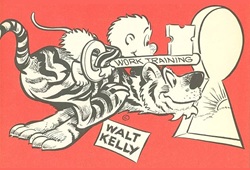
Art by Walt Kelly
Despite the ongoing Cold War with the Soviet Union, President Lyndon Johnson considered domestic issues the nation’s biggest challenge during the 1960s and vowed to build a “Great Society” that was free of racial discrimination, poverty, and other social ills within one generation’s lifetime. Peace Corps director Sargent Shriver was selected to oversee the project, whose centerpiece was a “War on Poverty” that relied on education programs to give the impoverished of the country the means to improve their economic conditions on their own.
A Jobs Corps and Neighborhood Youth Corps were created in 1964 as result, with the goals of each organization to help high school dropouts enter the work force by providing both training and employment opportunities. In order to reach the highest possible number of youths, Sargent Shriver thought outside the box and enlisted two of the most popular comic strip artists of the time period – Al Capp and Walt Kelly – to create comic books based on their Li’l Abner and Pogo characters that promoted the twin organizations.
Al Capp’s Li’l Abner and the Creatures from Drop-Outer Space was released first, in July 1965. As explained on the opening page of the comic book, Capp himself had once been a high school drop-out and even had a brush with the law as a youth. Since the goal of the comic book was to reach similar youths who fell through the cracks, the half million copies produced were meant to be distributed at pool halls and neighborhood newsstands, as well as given to counselors working with young Americans involved with street gangs.
The Li’l Abner comic strip had a readership of sixty million people at its peak and followed the misadventures of a good-natured country bumpkin from the fictional, impoverished mountain village of Dogpatch. In Li’l Abner and the Creatures from Drop-Outer Space, the title character meets the unemployed Danny Driftwood, who is attracted to a woman named Bouncy-Belle despite her unwillingness to give him the time of day.
Li’l Abner suggests that a steady job might make Danny more appealing to Bouncy-Belle and takes him to the local Job Corps office for training. A year later, Danny has found employment as an assistant technician. While Bouncy-Belle has a different opinion of him as a result, it is Sloppy-Belle – another unemployed high school dropout with a crush on Danny – who feels left behind. Comic strip regular Daisy Mae comes to the rescue, telling Bouncy-Belle that there is a division of the Job Corps especially designed for young women.
A few weeks before Li’l Abner and the Creatures from Drop-Outer Space was released, Sargent Shriver tried another “outside the box” approach to reach the youth of the country with the television special It’s What’s Happening, Baby, a variety show hosted by 38-year-old New York deejay “Murray the K” Kaufman.
“You can’t reach them on an intellectual level,” Kaufman explained to journalist Harvey Pack regarding the Office of Economic Opportunity’s target audience. “I can step out and talk to them in their own language and they dig. I’ve been doing it for years with the youth gangs all over the city. I’m not saying that I’ve saved anybody from a life of crime, but at least they listened to me. Once, a city agency asked to come along on one of my visits and I let them. One speech and we lost the whole group.”
It’s What’s Happening, Baby featured popular musical acts like the Dave Clark Five, the Supremes, Marvin Gaye, the Temptations, Ray Charles, and Jan and Dean interspliced with public services announcements about the EOC’s jobs training program. The show opened with a performance of “Nowhere to Run” by Martha and the Vandellas that was filmed outside a Ford automotive plant in Detroit. Like with Al Capp and Li’l Abner and the Creatures from Drop-Outer Space, each of the musical acts donated their time and talent.
Although a handful of Republicans in Congress criticized the endeavor afterwards, Sargent Shriver maintained that the show was an unqualified success. “Ten thousand letters have been received,” he wrote in a telegram to Barry Shear, the producer/director of It’s What’s Happening, Baby. “Three percent are critical. The remaining 97 percent made it clear that we reached the audience we sought and they understood what we were saying.”
In April 1966, Li’l Abner and the Creatures from Drop-Outer Space was on the receiving end of Republican criticism when it was revealed that 435,000 of its 500,000 copies had been gathering dust in warehouse for over nine months. In their “Republican Poverty Memo,” Congressmen Albert Quie of Minnesota and Charles Goodell offered two rumored explanations as to why the comic book was shelved. The first was that some OEO officials “felt the story portrayed in the comic book was controversial and characters did not fit the OEP image.”
The second rumored reason was that “a highly placed psychologist at OEO felt that distributions of the books with cards enclosed amounted to pressuring youths into Job Corps enrollment.”
OEO director Herbert Kramer confirmed that 435,000 copies of Li’l Abner and the Creatures from Drop-Outer Space were indeed being stored in a warehouse but maintained that it was because the Job Corps program had already achieved an unexpected level of success. “We got 300,000 applications for the job corps very quickly and we made the decision not to push recruitment,” he explained. “It would be pointless to distribute them now. At first, no one was sure what would be the response but now we don’t need this mass recruitment.”
A month after news broke that Li’l Abner and the Creatures from Drop-Outer Space had been shelved, the Department of Labor and its Neighborhood Youth Corps released a smaller illustrated booklet created by another high-profile comic strip artist – Walt Kelly – entitled Pogo: Welcome to the Beginning with the goal of connecting high school dropouts from low-income families with jobs available near their neighborhoods.
“The real first need is to capture the attention of these young people,” Jack Howard – administrator of the Youth Corps – said while presenting Kelly with the Department of Labor’s Award of Merit. “It must be done with tact and respect for their need and dignity. I would like to thank Mr. Kelly and his friends, the Hall Syndicate, for helping us start the job.”
The 28-page booklet had a smaller printing run than Li’l Abner and the Creatures from Drop-Outer Space, with 180,000 red editions earmarked for regular recruitment efforts, 25,000 green editions published in Spanish, and 25,000 blue editions for special recruiting. Hank Aaron and Eddie Matthews of the Atlanta Braves, for instance, canvassed neighborhoods in Atlanta handing out the blue pamphlets.
Walt Kelly’s Pogo comic strip premiered in 1948 and ran continuously until 1975. The series followed a group of anthropomorphic animals from Okefenokee Swamp in the Southeastern United States, most notably an opossum named Pogo. Pogo: Welcome to the Beginning consists of twenty-one single page panels that relate the benefits of having a job, the negatives of hanging out on street corners, and how the Youth Corps can help someone find employment as well as stay in school.
Within two years of its establishment in 1964, the Job Corps had opened close to three thousand men’s centers, more than eighty conservation centers, and seventeen women’s centers across the country. The Neighborhood Youth Corps, meanwhile, provided employment for hundreds of thousands of disadvantaged youths and young adults during the 1960s. Exactly how many of them were influenced by Al Capp and Walt Kelly is unknown, but Li’l Abner and Pogo were no doubt proud of the results nonetheless.
Anthony Letizia