

Art by Paul Cassidy
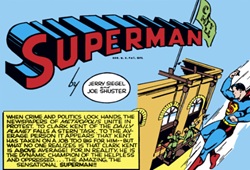
“Crime runs rife in the streets of Metropolis,” the opening page of Action Comics #37 declares. “Every form of racketeering flourishes with but little interference from the law, and whenever few and far-between arrests do occur, the prisoners are quickly released.”
There is one person in the city, however, who has had enough – Daily Planet reporter Clark Kent. “I tell you, White,” he says to his editor. “There’s a sinister link between certain crooked politicians and the criminal element in this town. We’ve got to do something about it!” Perry White not only agrees but solicits the support of other local newspapers to call for the ouster of current Police Commissioner Kennedy.
The mounting pressure forces the mayor to act but the new commissioner is gunned down outside his home shortly after being appointed. His replacement is subsequently killed by a car bomb and the next commissioner likewise encounters a hail of bullets. Faced with the task of finding yet another replacement for a job that no one now wants, Mayor Garson decides on a most unorthodox choice – Clark Kent.
Fellow reporter Lois Lane initially agrees. “Why not?” she rhetorically asks. “Clark has been leading this crusade for better government. What could be more fitting than that he temporarily assume the office of police commissioner?” Kent’s waffling, however, quickly changes her mind. “Oh, just skip it,” she now says. “For a moment I forgot that the Planet’s crusading ace reporter is notorious for his aversion to anything resembling a battle.”
Then, to her surprise, Clark Kent accepts the mayor’s offer.
The Justice Department’s Bureau of Investigation – renamed the Division of Investigation in 1933 and then Federal Bureau of Investigation in 1935 – was created in 1908 to investigate antitrust cases. According to Bryan Burrough in his 2004 book Public Enemies: America’s Greatest Crime Wave and the Birth of the FBI, 1933-34, its agents were primarily hired as political favors, and it became more infamous for corruption as opposed to any actual crime-solving skills.
Unsure of what to do with the Bureau of Investigation, newly appointed U.S. Attorney General Harlan Fiske Stone promoted its twenty-nine-year-old assistant director, John Edgar Hoover, as interim director in 1924. Eager to prove himself, Hoover began firing incompetent agents and replacing them with young men between the ages of twenty-five and thirty-five who were clean cut, intelligent, and well spoken.
“I want the public to look upon the Bureau of Investigation and Department of Justice as a group of gentlemen,” Hoover said in 1926. “And if the men here engaged can’t conduct themselves in the office as such, I will dismiss them.”
The was only one problem – the public had little knowledge of the Bureau’s existence. It’s authority was also limited. Agents were unable to make arrests, for instance, and if they wanted to raid a suspect’s home, they needed to be accompanied by local police. Furthermore, their jurisdiction was limited to a “grab bag” of offenses, such as interstate car theft, breakouts from federal prisons, and crimes committed on Native American reservations.
The early 1930s, meanwhile, witnessed an increase in high-profile kidnappings and a series of bank robberies by a growing assortment of notorious criminals, such as John Dillinger, Pretty Boy Floyd, and Machine Gun Kelly. Kidnapping became a federal offense in 1932, but only if the kidnapper or the victim crossed a state line. There were no federal laws against bank robbery, meaning that if the thieves made it across a state line, they were pretty much home free as local authorities were prohibited from entering another state in pursuit.
Lois Lane secures the assistance of a former criminal to fake a hold-up of Clark Kent and then allow the reporter to subdue him. “Can’t you see the headline?” she explains to her Daily Planet colleague. “‘New Police Commissioner Overcomes Thug.’ Your reputation as a fighting he-man will be made. Criminals will tremble at the mere sound of your name!”
Before Lane’s friend can confront Kent, an actual hoodlum with a gun corners him instead. “I’ll try not to hurt you,” Clark Kent mistakenly says. “Hurt me?” comes the replies. “I’m gonna blow your brains out an’ you say you’re not gonna hurt me!!” He fires his gun but Kent is able to dodge the bullet. The man then tackles his opponent and tries to strangle him. When that doesn’t work, he smashes Kent’s head against the ground. Kent in turn bounces his head upward, with the resulting headbutt knocking the hoodlum unconscious.
Upon discovering that the thug wasn’t Lois Lane’s friend after all, Clark Kent considers resigning as police commissioner, which inevitably causes Lane to walk away in a huff. Kent then changes into Superman to investigate some suspicious-looking characters on a scaffold outside the mayor’s office. One of them tosses an incendiary bomb through the window, trapping the mayor in a fiery inferno. Fortunately the Man of Steel is able to blow out the flames with his super breath.
After previous convictions for robbing an Oklahoma store and safe-cracking, Frank Nash was sent to jail a third time after assaulting a postal worker. He escaped from the U.S. Penitentiary in Leavenworth, Kansas, in 1930, putting him on the Bureau of Investigation’s radar.
Three years later, the future FBI received a tip that Nash was vacationing in Hot Springs, Arkansas, a popular resort town for gangsters. Two agents, along with an Oklahoma police chief, were able to capture Nash easy enough, and then loaded him into their car. Frank Nash had plenty of friends, however, who were determined to rescue him from the feds. Before the agents reached the city’s limits, they were pulled over by crooked police officers who were informed that a “businessman” had been kidnapped. Since the “kidnappers” were federal agents, they were allowed to continue, only to again be pulled over near Little Rock.
The agents phoned their boss when they stopped at a diner for a bite to eat. Hearing about how their car had been stopped twice, they were told to head to Fort Smith, Arkansas, and take a train to Kansas City. Unfortunately, a newspaper reporter noticed them at the station and asked about their prisoner. His article went out on the Associated Press’ wire shortly afterwards.
Once again, plans were changed – instead of taking a second train to Leavenworth, Nash would be transported by car from Kansas City. Just as everyone boarded the vehicle, a gunshot rang out. As the agents fired back, machine gun bullets pummeled the car. By the time it was over, two Kansas City police officers, one federal agent, the Oklahoma police chief, and Frank Nash were dead. The shooters, meanwhile, escaped.
Despite popular lore, it wasn’t FBI Director J. Edgar Hoover who subsequently declared a “War on Crime” but Attorney General Homer Cummings, who was already looking for ways to combat rising crime during the Great Depression. The Kansas City Massacre gave him the reason to enact his plans, which were quickly embraced by President Franklin D. Roosevelt as part of his New Deal. It wasn’t long afterwards that Hoover began issuing a series of “Public Enemy Number One” bulletins that led to the death or capture of John Dillinger, Pretty Boy Floyd, and Machine Gun Kelly – all under the direction of the newly minted Federal Bureau of Investigation.
Sergeant Casey tells Police Commissioner Clark Kent that he was informed by a stool-pigeon about a pending robbery at the Jewelers’ Exchange. “I was thinkin’ any gang nervy enough to try and get away with a big job like this might be the same that killed off the police commissioners,” he says.
Casey has positioned a number of police officers in key positions around the Jewelers’ Exchange while he waits inside with Kent and another officer. When Clark Kent excuses himself to make a phone call, Casey tells the officer to follow him. Instead of using the phone booth to change into Superman, however, Kent traps the officer inside and makes his transformation in a nearby office building instead.
It isn’t long before a speeding sedan turns off of the street and crashes through the doors of the Jewelers’ Exchange. As the police raise their guns to fire, the vehicle releases an anesthetic gas and makes a U-turn back onto the street. Superman is ready for them and crashes into the car, then rounds up the thugs inside.
“The driver of the holdup car is none other than your former Police Commissioner Kennedy,” Superman informs Sergeant Casey afterwards. “In reality, the head of the gang that has been terrorizing the town”
Back at the Daily Planet, editor Perry White tells Clark Kent, “What a swell yarn! This completely explains why criminals were able to get away with all of their crimes. But you need not resign as police commissioner now that Kennedy has been exposed.”
Kent simply replies, “I’ll stick to reporting.”
Anthony Letizia