

Between propaganda orchestrated by Adolph Hitler abroad and the continuing Great Depression at home, a rise in antisemitism began to take root in the United States during the 1930s. Sensing the danger, the American Jewish Committee embarked on a public relations campaign not only against antisemitism but all forms of hate and bigotry as well. A plethora of writers and artists were recruited, churning out magazine articles, information pamphlets, and even radio shows as part of the effort.
Cartoonists and comic book artists were also at the forefront of the campaign, creating one-panel comic strips and full-length comic books as part of a “secret war” against bigotry. In July 2022, the New York Historical premiered a temporary exhibit on the work of the American Jewish Committee – entitled Confronting Hate: 1937–1952 – that spotlighted many of those efforts.
“The success of Superman in 1937 had encouraged companies such as Real Comics and True Comics to publish illustrated stories of heroes battling evildoers,” the exhibit explained. “Comic books had become so popular by the early 1940s that the US military used them to teach soldiers about hygiene and weapon use. Colorful panels, expressive illustrations, and succinct dialogue made comic books perfect for AJC’s powerful human rights messages.”
In 1942, Scholastic magazine editor Kenneth M. Gould wrote a pamphlet entitled They Got the Blame: The Story of Scapegoats in History. It was subsequently sent to the publisher of True Comics, who had the narrative illustrated in 1943. Scholastic sent 17,000 copies of the resulting comic book to high school teachers across the country. The response was so overwhelming that 70,000 reprints were likewise mailed out to educators, with an additional two million copies sent to CIO and AFL labor unions as well.
Labor was also encouraged to join the anti-bigotry campaign through Joe Worker, a newspaper comic strip created by writer Nathan Schachner and artist Jack Alderman that ran for forty-six weeks in 1945 and 1946. “A war veteran, Joe returns home to find the management of his workplace trying to bust the union by stirring racial, ethnic, and religious divisions,” the Confronting Hate exhibit explained. “The dramatic story features romance, fist fights, and even murder as Joe battles management and advocates unity among workers.” The comic strips were eventually published as a comic book by the National Labor Service, with 1.5 million copies of Joe Worker and the Story of Labor distributed across the country.
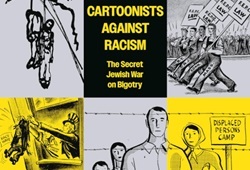
Although Confronting Hate at the New York Historical ended in January 2023, Rafael Medoff and Craig Yoe have kept the story of the American Jewish Committee’s efforts alive through their 2024 book Cartoonists Against Racism: The Secret Jewish War on Bigotry. Like with Confronting Hate, they consider advertising executive Richard R. Rothschild to be the major reason why the campaign was so successful.
Instead of arguing that Jews were victims of intolerance, Rothschild believed that antisemitism itself should be attacked as “bad for America and Americans.” He also thought the scope of the campaign needed to be broadened. “His strategy was to try to discredit all forms of racial, religious, and ethnic bigotry – not just antisemitism – in the eyes of the entire American public,” Medoff and Yoe write. “Antisemitism would be included among the targets, but it would not be the focus. In Rothschild’s view, many Americans would not take the issue seriously if it concentrated on just one narrow ‘ism,’ such as antisemitism. Taking on the broader range of prejudices was a way to help the public understand that all forms of bigotry were harmful.”
In addition to full length comic books, Richard Rothschild also utilized single-panel editorial cartoons that appeared in newspapers across the country to get his message across. Carl Rose – who drew “gag” cartoons for The New Yorker and Saturday Evening Post – came up with Mr. Biggott, who uttered such extreme comments in each cartoon that readers had no choice but to consider him foolish. A man being carried to safety from a burning building by a fireman, for instance, says, “I hope I’m being recused by a native-born American,” while an actual Native American is told in another comic strip, “I’m sorry, Mr. Eaglefeather, but our company’s policy is to employ 100% Americans only.”
One of the more popular newspaper comic strips at the time was the single-panel Ripley’s Believe It or Not, which contained a series of offbeat facts that readers found entertaining. Rothschild mimicked the style of Ripley’s for American Sidelights, with each single panel of the latter contained two historical events that average Americans might not know about, accompanied by a third message of anti-bigotry.
“The format of having two scenes unrelated to any message of tolerance and one that clearly promoted tolerance mirrored Rothschild’s broader strategy,” Rafael Medoff and Craig Yoe explain in Cartoonists Against Racism. “Three scenes pushing an anti-racism message would, in Rothschild’s view, seem forced or preachy. The more nuanced approach of mixing the message made the anti-bigotry portion more acceptable.”
Another example of how cartoonists were part of the overall campaign against bigotry was a series of large-size cartoons that served as public service announcements (PSAs) and were both displayed in public venues and published in newspapers and magazines as advertisements. PSAs also became popular within the pages of DC Comics. Created by the National Social Welfare Assembly, these one-page illustrations featured the likes of Batman and Superman imparting words-of-wisdom to young readers about everything from good sportsmanship to racial and religious tolerance.
Comic books and cartoons were obviously not the only weapons in Richard Rothschild’ arsenal. James Cagney and Helen Hayes were amongst the Hollywood actors who participated in a six-week radio serial called Dear Adolph that countered Nazi propaganda, while another radio serial – The Battle of Warsaw Ghetto – told the story of freedom fighters in Poland resisting German attempts to send Jews to the Treblinka death camp.
Despite the greater reach of radio, however, Rothschild never lost faith in the power of cartoons and comics, from full-length books to single panel strips. The cartoonists who became an important part of the American Jewish Committee’s campaign against bigotry proved that his faith was well-grounded.
Anthony Letizia
Explore more Political, Social, and Education Comics on Remixing History