

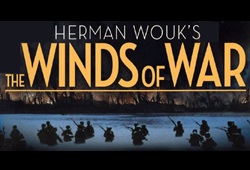
Although incorporating popular culture into the college classroom may be a growing trend in the twenty-first century, it was a rare occurrence during the early 1980s. “We were told it couldn’t be done,” Theodore Hengesbach, director of extended programs at Indiana University-South Bend, told the Associated Press in 1983. “Some people thought maybe we shouldn’t move into this area.”
Indiana University and a number of other colleges went against such conventional wisdom nonetheless when the ABC miniseries The Winds of War – based on Herman Wouk’s mammoth novel of the same name – aired in February of that year. Over eighteen hours long, the miniseries told the story of the fictional Henry family and their interaction with historical figures and the events that led to the United States entering World War II. Watched by an estimated 140 million viewers, The Winds of War was also the perfect vehicle to teach history to a populace hungry to learn more.
According to ABC at the time, at least four colleges incorporated The Winds of War into existing classes: the Bay Area Community College TV Consortium in San Francisco, Kennesaw College in Georgia, Lakewood Community College in Minnesota, and Springfield Technical College in Massachusetts. The University of Minnesota, meanwhile, offered “Europe During World War II” as a four-credit independent study course to coincide with the broadcast of the miniseries. Although the scope of the class was larger than The Winds of War – beginning with the rise of Adolph Hitler and Benito Mussolini and ending with the Nuremberg Trials – it was required watching nonetheless.
Patrick J. Furlong and Paul H. Scherer at Indiana University-South Bend went even further, creating a new three-credit course specifically centered in The Winds of War. “It’s a very rare opportunity,” Furlong told the Associated Press. “This is the single largest project ever undertaken by a television network,” adding that it was a way to “teach some history to people who might not take a history class. We can show them that history is more than a collection of facts and dates.”
Despite a handful of naysayers, Theodore Hengesbach, director of extended programs at the university, believed it was a valuable addition to the school’s curriculum. “Our hope is it will be for people who don’t have time to attend regular classes or people who were going to watch the show anyway and figured they might as well get some credit for it,” Hengesbach explained. “The question in all of these programs is quality assurance, that it is a college course that IUSB can be proud of. Scherer and Furlong are two of our best faculty people. Both are very vocal about quality. I feel very comfortable about those two doing it.”
A total of twenty-five students registered for the course, which was held over six consecutive Saturdays after the miniseries aired. Between the classes and the required eighteen hours of television viewing, the necessary number of hours for a three-credit course at Indiana University was reached. “It’s a perfectly orthodox history class,” Scherer noted.
One of the reasons for that orthodoxy was a twenty-page color magazine created by the nonprofit Cultural Information Service (CIS) that contained biographical sketches of the real-world historical figures seen in The Winds of War, timelines of both the factual and fictional storylines that stretched from the Nazi invasion of Poland in 1939 to the Japanese attack on Pearl Harbor in 1941, discussion questions centered on various topics, and a detailed bibliography for further reading. The organization had previously constructed similar viewer’s guides for the television miniseries Shogun, Masada, and The Blue and the Gray.
“We’re really trying to provide the resourcing and people can go from there,” CIS co-director Mary Ann Brussat explained to the Associated Press. “The universities can plug it into their regular curriculum or build some special program around it. A lot of colleges have used our material in the past. They find the popularity of the television program will get people to the campus and then realize all the other offerings of the university.”
It wasn’t just colleges that found The Winds of War magazine as a valuable education tool. “High schools have really used this,” an ABC spokesperson added. “I could give you the names of thousands of high schools that are using it.” Five hundred thousand copies of the viewer’s guide were initially mailed to various institutes of learning, with an additional three hundred thousand requests received afterwards.
“Just as the coming of war compels the characters in the drama to examine their values and decide where they stand, so ‘The Winds of War’ challenges viewers to consider such important issues as the nature of war and peace, the difference between isolationism and international cooperation, the repercussions of racism, and the clash between totalitarianism and democracy,” the viewer’s guide explains.
The Winds of War also provided an opportunity to teach history on a college and high school level at a moment in time when students were truly interested in learning more – something that is too often a rarity in the world of academia.
Anthony Letizia
Explore more Popular Culture College Courses on Remixing History