

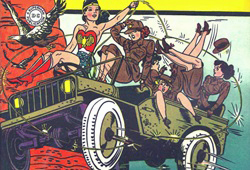
Cover art by Harry G. Peter
On the opening page of Sensation Comics #20, General Standpat orders Major Steve Trevor to accompany him on a training camp inspection. “There’s sabotage going on,” he explains. “Munitions, camp equipment. It’s serious – you’ve got to stop it! Worst is at Camp Doe where they’re training those WAACs – woman soldiers – bah!”
As Lena Andrews notes in her 2023 book Valiant Women: The Extraordinary American Servicewomen Who Helped Win World War II, the United States was ill-preprepared when it entered World War I, often having to rely on its European allies for supply lines to deliver food and equipment to its troops. When faced with the possibility of fighting on two fronts during World War II – one in the Pacific, the other in Europe – Army Chief of Staff George Marshall realized it would take a large number of military personnel to create and keep American supply lines open, to say nothing of the number of combat troops and factory workers needed as well.
“There are a great many jobs connected with the Army’s war program which women can handle better than men,” the general concluded, much to the chagrin of the fictitious General Standpat in Sensation Comics. “The demands on manpower would be so great that a large number of women should be incorporated in the Army’s effort.”
Major Steve Trevor requests to bring along his assistant, Lieutenant Prince, to Camp Doe. When the pair report to Standpat, however, the general is less than pleased to learn that Diana Prince is a woman. Although he ultimately consents with her coming along, General Standpat orders both Trevor and Prince to ride in the luggage car as opposed to his staff car.
Upon their arrival at Camp Doe, the female WAACs stand at attention while Standpat impatiently waits for the arrival of the camp commander. Suddenly a gunshot rings out and General Standpat collapses. After he is taken away by an ambulance, the camp commander – General Scott – assigns Steve Trevor to conduct an investigation. He is also informed that Standpat exclaimed “A woman shot me!” upon being hit.
“A woman, eh?” Scott replies. “Must be some hysterical WAAC in Training Company A – bullet came from their direction. I’ll place the entire company under arrest!”
Congress and a large segment of the American populace were initially against women serving in the military. “Who then will do the cooking, the washing, the mending, the humble homey tasks to which every woman has devoted herself,” one congressman lamented. Congresswomen Edith Nourse Rogers, however, had a different viewpoint. During the spring of 1941, she informed General George Marshall of her intent to introduce legislation calling for the inclusion of women in the military. Marshall at first asked for a week extension, then a month, to study the bill.
Although the general’s counterproposal was the creation of a “civilian auxiliary corps” that would be under the authority of the Army but not officially part of it, Congresswomen Rogers understood the need for political compromise given the strength of the opposition. Even then, it took over a year and the personal interventions of Marshall and Secretary of War Henry Stimson to get the legislation passed.
“For the first time in the history of our nation, women may volunteer for direct service to a national war effort with the army of the United States,” the War Department announced on May 16, 1942, regarding the newly formed Women’s Army Auxiliary Corps (WAAC). “Some of these jobs will be dramatic; many will be monotonous. All will be important.”
Lieutenant Diana Prince is not convinced that a WAAC was responsible for shooting General Standpat but searches each of them as ordered nonetheless. To her surprise, she discovers a .22 pistol hidden in a WAAC uniform. Prince is even more surprised when she recognizes the suspect as Marva Psycho, who the supervillain Doctor Psycho once placed under a hypnotic spell so that she would marry him. After freeing Marva from Psycho’s control, Wonder Woman told her, “Get strong! Earn your own living – join the WAACs or WAVES and fight for your country! Remember the better you can fight, the less you’ll have to.”
Although Marva Psycho heeded Wonder Woman’s words and joined WAAC, she now lies to Diana Prince, insisting that her name is Jane Gray and that the gun found hidden in her uniform was for protection. Prince first uses a traditional lie detector and then Wonder Woman’s lasso of truth, compelling the WAAC to admit that her name before marrying Doctor Psycho was Marva Jane Grey.
Unfortunately Steve Trevor interrupts the interrogation before it can progress any further and Marva takes advantage of the distraction by escaping with the lasso of truth. When later confronted by Wonder Woman, she uses it to force the Amazon princess to switch places with her. Marva then heads off as Wonder Woman while Diana Prince – masquerading as Jane Grey – joins the rest of the WAACs.
General Scott eventually sees through the charade and orders them to switch clothes. After the two are bound together by Wonder Woman’s lasso of truth, Marva finally confesses what she knows. “A cleverly disguised Nazi agent came here to the destroy the ammunition dump,” she begins. “I recognized him as Stoffer, a former associate of Dr. Psycho.” Stoffer likewise recognized Marva, and told her to keep her mouth shut or else he would have her arrested as an accomplice to Doctor Psycho’s crimes.
When General Standpat later arrived at the training camp, Stoffer shot him and then framed Marva. To prove her innocence, Marva switched places with Wonder Woman in the hopes of soliciting a confession using the lasso of truth. With her hands now bound by that same lasso, she reveals that General Scott is really Stoffer. The Nazi kidnapped the actual General Scott and masqueraded as him so he could sabotage Camp Doe. He then shot Standpat since the general knew Scott and would see through the deception.
With the truth exposed, Stoffer knocks Marva and Wonder Woman unconscious and orders his men to place them in a waiting ambulance. Wonder Woman is faking her injury, however, and discovers a bomb hidden underneath the vehicle. Using her super strength, she throws the ambulance into the air, where it hits the helicopter containing an escaping Stoffer just as the bomb detonates.
After General Standpat recovers from his wounds, he presents Marva Jane Gray and Wonder Woman with medals. “For heroic action, I commend these brave soldiers – ahem – brave women – harrumph!” he manages to mutter as sweat pours down his face.
From the very beginning, the women who volunteered for WAAC exceeded expectations. The Army hoped for eleven thousand recruits during the first year – over sixty thousand signed up. The first two months of basic training essentially followed the same routine as their male counterparts, waking up at 0530, attending morning flag raising at 0630, then classroom training and outdoor calisthenics and marching. Despite the rigorous and repetitious nature of each day, the vast majority of recruits were unfazed. “We have found that women respond more quickly and rhythmically to drill and marching then men,” one of the training officers remarked. Another added, “You couldn’t make them complain.”
General Dwight Eisenhower was initially skeptical of women serving near combat zones. Then came the Battle of Kasserine Pass in North Africa, a major defeat for the Americans in 1942. Although the enemy had been underestimated, poor communication played a key role as well – Eisenhower simply didn’t have the necessary staff to sort through the deluge of information pouring into his headquarters and relay it to him in a timely manner. He thus put in a request for a detachment of trained WAAC typists, opening the doors for addition WAACs to make their way across both the Atlantic and Pacific Oceans soon afterwards.
Although many of their assigned tasks were within the clerical and administrative fields, women also served as aircraft trainers and gunnery instructors, mechanics and truck drivers, radar operators and codebreakers, control tower operators and pigeon trainers. Like with basic training, they exceeded expectations and played a key role in the overall war effort.
None of which, of course, would have come as a surprise to Wonder Woman.
Anthony Letizia
Explore more Comics and History: The 1930s and 1940s on Remixing History