

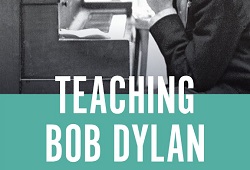
Edited by Barry J. Faulk
Although he disliked the term, Bob Dylan was known as the “voice of a generation” during the 1960s, with early songs like “Blowing in the Wind,” “A Hard Rain’s a-Going to Fall,” and “The Times They Are A-Changin’” capturing the zeitgeist of the decade. His songs about civil rights even earned him an appearance at the 1963 March on Washington, where Martin Luther King Jr. gave his famous “I Have a Dream” speech.
The teaching of Bob Dylan is thus a teaching of the historical 1960s itself. In his essay “Teaching the ‘Revolutions’ of the 1960s through Bob Dylan” from the 2024 anthology book Teaching Bob Dylan, Carnegie Mellon University professor David Shumway explains how he personally has used Dylan to help students maneuver their way through the cultural and political upheavals of the decade. During the course, classic Dylan songs are first listened to in the classroom. Students are tasked afterwards with reading both secondary histories and historical documents as homework. Discussions on how the songs intersect with the history of the 1960s are then discussed during the following class.
Instead of beginning with John F. Kennedy’s inauguration as president or a nineteen-year-old Bob Dylan’s arrival in New York City – both of which occurred in January 1961 – Shumway uses the 1950s as his starting point. “The course begins with a unit on the folk music revival, the cultural movement that gave Bob Dylan his start,” he writes. “It is important also because it represented a connection between the old left, which McCarthyism had largely decimated, and an emerging new one. Woody Guthrie, one of Dylan’s most important influences, was also a major influence on the folk revival.”
Like Guthrie, Dylan wrote his own songs, many of which were based on real world events such as the emerging Civil Rights Movement. While students today may only have a basic understanding of that movement, David Shumway uses songs that Bob Dylan wrote at the time – such as “Oxford Town,” based on James Meredith’s efforts to be the first African American enrolled at the University of Mississippi, and “Only a Pawn in their Game,” which addresses the murder of civil rights activist Medgar Evers – as a way to expand their knowledge, supplemented by excerpts from the award-winning documentary Eyes on the Prize and class lectures.
As Dylan moved away from songs explicitly about the Civil Rights Movement, his compositions evoked a more general critique of culture and society, with many of them dovetailing with the beliefs of Students for a Democratic Society, the largest New Left organization of the 1960s. Former SDS president Richard Flecks once remarked, “To understand The Port Huron Statement, you have to understand Bob Dylan,” and David Shumway analyzes Dylan’s songs as a way to explore the organization’s founding document.
When the radical Weathermen gained control of SDS at the end of the decade, meanwhile, they took their name from a line in Dylan’s “Subterranean Homesick Blues,” adding to the singer’s connection with the New Left, albeit an unintentional one.
Although Bob Dylan never directly addressed the Vietnam War, many of his early songs – “With God on Our Side,” Masters of War,” and “A Hard Rain’s a-Going to Fall” – had an antiwar undertone, especially within the context of the Cold War between the United States and Soviet Union. As demonstrations against the Vietnam War increased as the decade progressed, these songs took on a new meaning for protesters. They also provided a blueprint for other musical artists, such as Phil Ochs and Country Joe and the Fish, for composing their own songs. Instead of focusing on the war itself, David Shumway spotlights the different forms of protest used against the war, including a cross-section of protest songs.
“Not all of the changes taking place during the 1960s were political,” Shumway notes in Teaching Bob Dylan, specifically referring to the rise of a counterculture in San Francisco’s Haight-Asbury neighborhood. “The counterculture was oppositional to many aspects of traditional culture, but it did not in general seek to promote change by political means. Rather, it was characterized by new ways of living, new styles, new attitudes, and new aesthetics.”
While Dylan wasn’t directly part of the counterculture per se, he was influential nonetheless, with many of his songs embracing the same “desire for greater individual freedom” and “personal rebellion” advocated at the time, such as “Maggie’s Farm” and “My Back Pages.” Shumway not only explores those compositions but the works of other musicians more closely associated with the counterculture, such as Jefferson Airplane and the Grateful Dead.
“During the 1960s, we saw the beginning of a significant change to culture and society in the United States,” David Shumway concludes in Teaching Bob Dylan. “Most students are at best dimly aware of these changes, and they associate the 1960s with what is called nostalgia for dress, music, and other cultural forms.” He also writes that “these changes have so strongly shaped the United States of (the) 2020s that it is hard to imagine what our life would be like had the 1960s not happened. The course shows not only how important the 1960s movements were, but how this history help not only make sense of Bob Dylan’s songs and records but also to enrich our experiences of them.”
Bob Dylan once sang, “The answer is blowin’ in the wind.” Over sixty years later, the same can be said of his music and the decade they helped shape.
Anthony Letizia
Explore more from the Education Library on Remixing History