

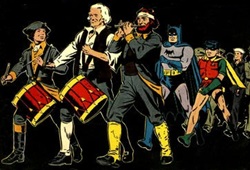
Cover art by Jack Burnley
In Detective Comics #78 – published in August 1943 – Dick Grayson is doing his history homework when he mentions to Bruce Wayne that there were similarities between the American Revolution and World War II. “You right!” Wayne exclaims. “In ’76 we fought for freedom from tyranny and we’re doing it again today.” Grayson then adds that more Americans might buy war bonds if they understood the connections.
The next day, Batman places a newspaper ad for anyone sharing a physical resemblance with a famous figure from the American Revolution. “I’m organizing a Bond Wagon,” he tells the media. “I hope to sell war bonds by restaging stirring pages from ’76 and so wake up the public.”
It doesn’t take long before Batman and Robin have found their George Washington, Betsy Ross, and Patrick Henry. They hit the road shortly afterwards, with their first restaging being the capture of Fort Ticonderoga by Ethan Allen and his Green Mountain Boys. The traveling campaign has so much success at selling war bonds, however, that German Nazis stationed in the United States decide that the Bond Wagon needs to be stopped.
Since the next reenactment is the Battle of Trenton – in which General George Washington and his Continental Army fought against a garrison of German Hessians – the Nazis decide to participate in the restaging, only with real guns. They easily overtake the actors hired to portray the Hessians at a nearby tavern just as the pretend Washington and his men duplicate the real Washington’s crossing of the Delaware on the night of December 25, 1776.
Robin is trapped inside the tavern with the Nazi Hessians and sends smoke signals from the chimney to warn Batman. While George Washington had a boat to take him across the ice-filled river, the Caped Crusader is forced to leap from one piece of floating ice to the next to get to the other side. He then makes his way to the tavern and throws gas pellets through the window. As the “Hessians” stumble out the door coughing, General Washington and his men attack.
Legend has it that the real Hessians were taken by surprise because of a heavy night of drinking. According to John E. Ferling in his 2007 book Almost a Miracle: The American Victory in the War of Independence, however, fifty Virginian soldiers had earlier snuck into Trenton and raided the city. As a result, the Hessians were not expecting a second attack. The severe snow and wind that delayed Washington’s crossing of the Delaware likewise led the enemy to let down their guard – who, after all, would launch an assault in such miserable weather?
When the rebel forces began firing their weapons, the response from the awakening Hessians was disorganized and quickly collapsed into chaos. Colonel John Rall tried at first to rally his men, then lead a retreat to a nearby apple orchard that provided better cover. Both were to no avail, and Rall himself fell victim to two gunshot wounds. In less than hour, the remaining Hessians had surrendered.
One of the persons interviewed by Batman while putting together his Bond Wagon was a former merchant marine whose ship was sank by a German destroyer. Wounded, he drifted on a raft for days before being rescued. While his body recovered, his mind was haunted by the experience. “Now I’m Matt Wilkins, the coward,” he tells Batman. “The captain without a ship.”
The Caped Crusader replies that it took courage for Wilkins to recite his story and hires him to command the Bonhomme Richard as Captain John Paul Jones. During the later reenactment, a Nazi submarine appears and Matt Wilkins is quickly overcome with fright. “They’re not going to blast this ship alone,” Batman tells him. “But the Bond Wagon, and the morale of Americans on farms, in factories, homes. Our armed forces. Can’t you see that?”
The words have their desired effect and Wilkins is soon telling his men to load the cannons and fire at the sub. The Nazi fire back, however, and their weapons are obviously more powerful. They order Matt Wilkins to surrender but instead the captain musters his internal John Paul Jones and shouts, “Give up? I’ve not yet begun to fight!” Fortunately Batman and Robin are able to sneak aboard the Nazi submarine and incapacitate the crew, ending the battle.
In 1777, Captain John Paul Jones set sail from America and headed to England, where he hoped to raid ports along the country’s coastline. During the spring of 1778, he successfully captured a British frigate, two merchantmen cargo ships, and 200 enemy sailors, spreading fear amongst the British in the process. With France preparing its own invasion of England, Jones was selected to serve as a decoy, with the flagship of his small fleet being the Bonhomme Richard.
While on patrol, John Paul Jones spotted a British commercial fleet returning home under the watchful eye of the Royal Navy frigate Serapis. Within hours, the Bonhomme Richard and Serapis were side-by-side. When a gunshot rang out, each began bombarding the other at close range. The Bonhomme Richard experienced the worst of it and was even rammed by the Serapis, resulting in the two ships becoming intertwined. British Captain Richard Pearson called out to John Paul Jones, asking if he required “quarters,” to which Jones reportedly replied, “I have not yet begun to fight!”
Another person interviewed by Batman was Pete Arnold, a former college football quarterback who was accused of throwing the Rose Bowl in order to pay off gambling debts. “My passes were off because I was sick,” he now tells Batman. “But I had to play! I wanted to win for my school. Instead I lost and now they call me ‘Benedict’ Arnold.” Batman not only believes him but says, “You resemble a certain American, a man who gave his life so as not to double-cross his team. You can be Nathan Hale!”
Given his reputation, one of the German Nazis later approaches Pete Arnold and tells him, “I can take you to a man who vill give you much money – if you vill sabotage de Bond Wagon.” Admitting that he could use the cash, Arnold says yes. Robin overhears the conversation, however, and imitates Paul Revere’s midnight ride by taking off on horseback to inform Batman. After defeating the German Nazis once and for all, the Dynamic Duo find Arnold laying on the ground, shot by the Germans for asking too many questions – he wasn’t betraying Batman after all, just trying to get intel on the enemy.
In February 1777, Congress promoted five army officers to the rank of major general who were below Benedict Arnold in terms of both seniority and military capacity. Although the primary reason was to keep the number of high-ranking officials evenly divided between the thirteen states – Arnold was from Connecticut, which already had two major generals – the future traitor took it personally, telling George Washington that the lack of promotion was “an implicit impeachment on my character.” Congress later rectified the slight, although without restoring Arnold’s seniority over the other five.
While serving as military governor of Philadelphia in 1778, meanwhile, Benedict Arnold was continuously accused of pilfering the confiscated property of British sympathizers and selling them on the black market. He soon had enough of the accusations and contacted British General Henry Clinton about defecting. His initial asking price was twenty thousand pounds and command of his own troops. Clinton added the British takeover of West Point as a condition.
With the position of West Point commander currently vacant, Arnold successfully lobbied General Washington for the job. On September 18, Washington made his way from Hartford to West Point and crossed the Hudson River by ferry. Benedict Arnold sent word to a British warship anchored nearby but the message arrived too late for any action against the commander-in-chief of the Continental Army to be taken by the enemy.
One week later, British Major John André was captured while traveling undercover to West Point. Documents on Arnold’s defection were found in his stocking and given to George Washington when he returned to the area two days later. By then, Benedict Arnold was long gone, leaving Washington to wonder out loud, “Whom can we trust now?”
Batman has a different sentiment regarding Peter Arnold, telling the former quarterback, “I’m glad I picked you to play Nathan Hale.” The Caped Crusader then heads for Philadelphia and a reenactment of the signing of the Declaration of Independence – as well as the end to the Bond Wagon’s journey through the American Revolution.
Anthony Letizia