

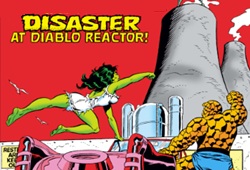
Cover art by Alan Kupperberg and Frank Giacoia.
Diablo Canyon lies on the Pecho Coast, a small stretch of land located halfway between Los Angeles and San Franscisco. When Pacific Gas and Energy (PG&E) first announced plans to build a nuclear power plant there during the 1960s, residents of San Luis Obispo County were in favor of the project, especially with the promise of cheap energy and a new source of tax revenue. During the early 1970s, however, news reports began appearing about radiation dangers and flawed reactor designs at other power plant sites and doubts began to emerge as a result. When a fault line was discovered just three miles away from Diablo, the fear of an earthquake unleashing a nuclear disaster turned those doubts into protest.
In Marvel Two-In-One #88, the Thing – currently in Los Angeles without his Fantastic Four teammates – is visited by Stephen Edward Shields, president of the Pacific Energy and Utility Company, and his assistant Rodney. “We’re here, Thing, because a masked man has been killing top official in our company,” Shield says. “The madman is waging a bloody vendetta against PE&UC, and he won’t tell us why! He demands no money – nothing! He just kills!”
The Thing initially brushes it off as a matter for the police handle, so Shields shows him the latest video received by the masked man, who calls himself the Negator. “Observe behind me,” the villain begins. “Your new Diablo nuclear reactor, waiting to be activated. But the uranium rods shall never arrive! I will have plucked them from your guards as effortlessly as I hurl this car. Then I shall destroy this reactor – and Los Angeles – in an atomic holocaust!”
The Thing agrees to accompany Shields’ assistant Rodney to a secret location where the truck transporting the uranium rods will pick him up. Unfortunately the engine on the company jet that Thing and Rodney are using as transportation begins to overload. Knowing that a parachute would never be able to handle his weight, Thing pushes Rodney out of the craft without him. Fortunately the superhero is able to straighten the plane at the last minute to reduce the damage and survive the crash.
According to John Wills in his 2006 book Conservation Fallout: Nuclear Protest At Diablo Canyon, the anti-Vietnam War organization Mothers for Peace shifted its focus in 1973 from protesting the war to preventing the Diablo Canyon nuclear power plant from being built. Their efforts failed to gain traction, however, until the discovery of the Hosgri Fault, located just 2.5 miles from Diablo Canyon. Although the Diablo Plant was designed to withstand a 6.75 maximum tremor, geologists predicted that the Hosgi fault earthquake could reach as high as 7.5 and trigger a “major” seismic event that would be seven times more powerful than PG&E had anticipated. Despite the risk, the Nuclear Regularity Commission still allowed construction to move forward.
In February 1976, the Continental Walk for Disarmament and Social Justice passed through San Luis Obispo on its way to Washington, D.C. Several of the walkers made a quick trip to Diablo Canyon, where they held a silent vigil on PG&E property. The act of civil disobedience convinced Mothers for Peace that direct action against the nuclear power plant was a better option than challenging the plant through legal means. The Continental Walk also introduced Mothers for Peace to other likeminded organizations in California, resulting in seven of them banding together as the Abalone Alliance later that year.
On March 28, 1979, an automatic shutdown occurred at Metropolitan Edison’s nuclear power plant on Three Mile Island when the reactor “scrammed” and control rods entered the core to stop the nuclear fission process. A valve that should have closed remained open, causing water meant to cool the reactor to flow through it instead. The Emergency Core Cooling System kicked in to compensate but the shift foreman – unaware of the extent of the situation – shut down the system’s pump. The core immediately began to overheat and melt as a result, threatening thousands of Pennsylvania residents in the process.
Back in Los Angeles, Jules McClure of People to Protect Our Environment receives a previously scheduled phone call. “Negator!” McClure says to himself. “When he approached me months ago, about working behind the scenes to stop activation of the Diablo reactor, I never dreamed that the ‘infallible inside track’ he spoke of was murder. I’m in deep – too deep – but I’ve got to somehow stop this madness before he slays again!”
McClure tells the Negator that he’s already deposited the money previously demanded as payment but is also canceling the contract. The supervillain replies that it is too late. “You should still be more than satisfied with the results,” he adds. “For at this time tomorrow, not only will Diablo reactor never function, but I shall have caused the whole nuclear industry to grind to a halt!” He then shoots McClure from a window across the street, killing him instantly.
The Thing, meanwhile, has made his way from the isolated scene of his plane crash to an equally isolated gas station. The owner is watching television, a commercial for Wacky Willie’s Wheels that feature She-Hulk. Thing finds the idea of a superhero peddling products on TV as repulsive, but She-Hulk only took the job in exchange for the pink Cadillac convertible currently sitting on Wacky Willie’s used car lot. As fate would have it, She-Hulk and her newly acquired convertible are the only ones to stop when Thing is unable to find a ride at the gas station and forced to hitchhike instead.
It was two years after Three Mile Island that the National Regulatory Commission finally approved low level-power testing at Diablo Canyon. The Abalone Alliance responded by launching a full-scale blockade. Protesters set up camp in Los Osos Valley, located eight miles northeast of the site, while 500 National Guardsmen and 270 highway patrolmen were sent to assist the local sheriff’s department. The assault began on September 15, 1981, when the first group of protesters approached the gates of PG&E. Another group hiked through the mountain to get to the plant, while yet another contingent landed at Diablo Cave in a boat.
By the time the protest reached the two-week mark, close to two thousand arrests had been made. After one last blockade on September 28, a representative from the Abalone Alliance announced the end of the demonstration while emphasizing that their overall effort still continued. Ironically, PG&E announced the same day that pipes had incorrectly been installed in one of the reactors, leading the NRC to suspend the plant’s operating license indefinitely.
Between She-Hulk’s erratic, high-speed driving and her incessant flirting, the Thing is grateful when he sees the Diablo nuclear reactor on the horizon. The Negator – who turns out to be Stephen Shields’ assistant Rodney – sees them as well, and closes the large metal gates at the entrance to the plant. Undeterred, She-Hulk speeds up and uses an elevated clump of land to flip the Cadillac sideways and make it inside just as the doors close. She then goes after the Negator while Thing searches for the uranium.
Standing on top of the power plant with the Pacific Ocean over three hundred feet below, the Negator believes he has the upper hand and reveals the reason for his murderous actions. “I am dying from radiation sickness,” he explains. “Once I was strong, healthy. I labored in a uranium mine. It was only after I worked my way up to my present position, that I discovered the accumulated exposure to the unusually-rich ore had ruined my health. Thus was born the Negator – the avenging angel of death!”
Underestimating the strength of She-Hulk, Negator is thrown off the top of the Diablo nuclear reactor. He is wearing a jetpack, however, which keeps him from crashing into the ocean. As he swoops down to attack the superheroes, Thing and She-Hulk wrap a wire fence around him. Trapped, the Negator confesses that not only did he hide the uranium rods inside the reactor but started a chain reaction that will cause the plant to explode in a matter of seconds. With time running out, Thing attaches the Negator’s jetpack to the uranium core, which She-Hulk then hurls into outer space, preventing a nuclear disaster in the process.
In November 1983, the National Regulatory Commission authorized fuel loading for the Diablo Canyon Unit 1 reactor. By then, the wind had gone out of the sail of the Abalone Alliance. Although protests were again held outside the Diablo plant, the number of participants drastically dropped from two years earlier. The power plant was officially commissioned in May 1985, and has remained operational ever since.
Anthony Letizia