

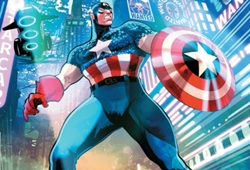
Cover art by Lucas Werneck
In early August 2026, the Marvel What If…? comic book series asked the question, “What if Captain America was revived in 2099” and missed the early part of the twenty-first century, resulting in a United States ruled by corporations instead of people?
Twenty days later, historian Jill Lepore published her nonfiction The Rise and Fall of the Artificial State, speculating on a not-so-distant future where the U.S. government is controlled by billionaire technocrats relying on artificial intelligence and algorithms to maintain power. Both serve as a warning – both also offer hope for a future that includes a “government of the people, by the people, for the people,” just like the one that Abraham Lincoln spoke so eloquently about following the Battle of Gettysburg.
“The United States of America – a subsidiary of Alchemax Stark-Fujikawa,” Steve Rogers is told in 2099 as he looks out at a Washington, D.C. skyline dominated by towering buildings etched with the names of the Rand Corporation, Parker Industries, Roxxon International, and a solitary “A” standing for Alchemax Stark-Fujikawa (A.S.F.). “Well, it’s not actually a ‘subsidiary,’ per se. But A.S.F. is the current president. And has been for the past nine years.”
Since it would take too long to explain how it happened, Rogers is given the short version. “In 2010, the Supreme Court ruled that corporations have First Amendment rights. From there, it’s really not much of a leap to say they’ve got the right to run for president too. And A.S.F. could stay ‘president’ ever since the court declared term limits unconstitutional.”
During his annual State of the Union address, the CEO of A.S.F. reports that both country and corporation are strong, that A.S.F. has “eliminated crippling regulations – including antitrust laws – and welcomed in a golden age of mergers and acquisitions.” As a result, ninety-nine percent of the population works in some capacity for A.S.F. When Steve Rogers asks why no one has ever fought against them, he is told that mutants initially tried and were branded “domestic terrorists” for their efforts. The Mutant Registration Act of 1981 was subsequently changed to include “anyone with even the most minor genetic anomaly,” allowing them to be rounded up by the government and taken to “relocation camps.”
In The Rise and Fall of the Artificial State, Jill Lepore writes, “The Artificial State is an unfinished digital communications infrastructure with which governments and especially private corporations organize and automate political behavior and public discourse by way of everything from direct mailing and robocalls to predictive algorithms, social media campaigns, AI agents, and bots (programs that mimic and often pass as humans). Within the Artificial State, nearly every element of public and democratic life – civil society, representative government, an informed citizenry, equality of rights, freedom of thought, freedom of expression, and faith in elections – is vulnerable to subversion through reduction of politics to the digital manipulation of attention-mining algorithms, the trussing of government by corporate-owned digital architecture, the diminishment of citizenship to minutely message-tested online engagement.”
As Lepore explains, it didn’t start out that way. Advances in technology were initially seen as a way to strengthen democracy, not weaken it. In 1997, for instance, the U.S. Supreme Court noted that internet access meant “any person with a phone line can become a town crier.” In his 2006 book The Wealth of Networks, meanwhile, Yochai Benkler wrote that social media would allow people to flourish “as autonomous individuals, as citizens, and as participants in culture and communities.” Close to ten years later, that same Yochai Benkler coauthored Network Propaganda, which declared that “the American online public sphere is a shambles.”
Jill Lepore uses the story of Twitter – launched in 2006, the same year that The Wealth of Networks was published – to demonstrate how the mood shifted. Twitter was originally conceived to be nothing more than a series of group text containing “short burst(s) of inconsequential information.”
Instead of tweeting about what one had for lunch, however, interested parties began using Twitter for political purposes. Barack Obama, for instance, effectively leveraged Twitter to solicit votes during his 2008 campaign for president. The following year, Republican Newt Gingrich stated that “using Twitter to bypass traditional media and directly reach voters is definitely a good thing.”
Twitter and other forms of social media initially lived up to its liberating hype, playing key roles in the Arab Spring of 2010 and 2011, Occupy Wall Street in 2011, and the emergence of Black Lives Matter in 2013. As Jill Lepore notes, however, “Revolutions make corporations uneasy,” especially when those corporations are in negotiations to expand their market into countries like China. To gain access to a potential 650 million new users, Facebook agreed to give the authoritarian Chinese government access to its data. That same year, the social media giant consented to take down a page promoting a rally supporting opposition leader Alexei Navalny at the request of the Russian government.
In 2018, the Daily Telegraph wrote, “Today the internet isn’t about the communication revolution anymore, it’s about the data revolution and the data revolution doesn’t empower people, it doesn’t empower individuals, it empowers big organisations that control data.”
Ultimately, social media companies use that data to increase profits for their shareholders. “Despite public mission statements like Twitter’s in 2017 – ‘Give people the power to share and make the world open and connected’ – social media’s real mission is to sell advertising by targeting specific audiences,” Lepore writes. “They are able to do this with precision because of the constant stream of data it collects on each users likes and dislikes, internet usage, online purchases, and every other electronic interaction imaginable.”
In the past, it was the message that mattered. In the twenty-first century, however, the messenger – Facebook, Twitter, AI, etc. – doesn’t just deliver the message, it controls it as well. Tech companies also control the gateway. The message can likewise be manipulated or even fabricated to suit the messenger’s needs and promote its agenda without anyone being the wiser, potentially turning a democracy into a technocracy as a result.
In the What If…? universe of 2099, Captain America rallies the populace to fight a second revolutionary war against A.S.F. and its CEO, who turns out to be the Red Skull. Afterwards, Steve Rogers addresses the country. “The second American Revolution is over,” he begins. “But it is not finished. It is never finished. It has to be fought every day. In our churches and our state legislatures. In our hearts and in our minds. It has to be fought with our voices and our votes. Let the word go forth from this time and place – no longer can we indulge in despair and apathy. No longer can we use false equivalence to shield ourselves from the responsibility to remain engaged. No longer can we pretend our voices don’t matter. Our voices do matter. In a democracy, every voice matters.”
At the end of The Rise and Fall of the Artificial State, Jill Lepore writes, “The architects of the Artificial State had no interest in democracy; nor did they have a theory of governance, or any interest in the rule of law, or any capacity of restraint. Yet everything destructive that they have done can be undone by voters, elections, legislation, and judicial enforcement, and by a commitment to the self-evident truths proclaimed two hundred and fifty years ago, ‘that all men are created equal, that they are endowed by their Creator with certain unalienable rights, that among these are Life, Liberty, and the pursuit of Happiness.”
Two messages, eerily similar, about a future that has yet to arrive but could be just around the corner nonetheless.
Anthony Letizia