

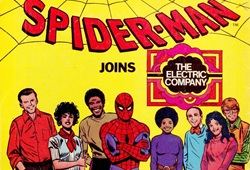
Back cover art by John Romita Sr.
The popular children’s television show Sesame Street premiered in 1969, the brainchild of Joan Ganz Cooney, Jon Stone, and Jim Henson and produced by the Children’s Television Workshop (CTW). More than mere entertainment, Sesame Street was an educational program designed to teach young kids the alphabet, numbers, and basic reasoning skills. Two years later, The Electric Company made its debut, geared towards children age six to ten who had “graduated” from Sesame Street but still containing the original’s goal of teaching as well as entertaining.
The cast included such acting heavyweights as Morgan Freeman, Rita Moreno, and Bill Cosby. In season four, a new member joined the ensemble – the Marvel Comics superhero Spider-Man. Not only did puppeteer Danny Seagren portray the webslinger in short, five-minute segments known as “Spidey Super Stories” on the show itself, however, but The Electric Company and Marvel likewise teamed up for a comic book version of Spidey Super Stories geared towards the same age group as the television series.
“The comic book had rules because they were specifically targeting older readers who were behind, who were not caught up with their pears,” Britton Payne explained at WonderCon in March 2026 during his popular “After 50 Years, Why Do Spidey Super Stories Comics Still Matter to Autistic Kids and Everybody Else?” panel. “Some of the rules included the fact that they were simplified but still big-kid art design. That was really an important part of this. When you think now about the current version of little kids’ Spidey – it’s Spidey and His Amazing Friends, wonderful show – big heads, big feet. Little kids stories, little kid look to it. But the idea was, we want to get the kids who want to get big boy comics who just can’t read at that level.”
Decades after the series ended, Britton Payne discovered that Spidey Super Stories were still capable of fulfilling its mission. “My son’s autistic and he was getting old, he was aging out of the little kids’ books that were in front of him but not finding something that could bridge him to where (he needed to be),” he told attendees at WonderCon. “I was not a big Spidey Super Stories reader when I was a kid. I only had two of them in my collection – I still have every comic book I ever had so to have two comic books from the 1970s is not an indication that I loved it, it’s an indication that they were on the backburner for me. But he found them, he liked it, he thought they were fun. And I didn’t quite realize why. So I sort of looked into it.”
Payne’s research led him to Jim Scalicrup, the writer for Spidey Super Stories from issue 15 through 57, the last one published. Scalicrup kept all of his notes from the 1970s and perusing them allowed Britton Payne to gain a better understanding of how the comic books were specifically targeted towards young readers who were struggling, just like his autistic son in the twenty-first century.
“CTW did a couple of things,” Britton Payne explained. “They tested comic book reading conventions with second, third, and fourth grade reading levels. They were trying to figure out how did kids read stories, and how were they going to incorporate that into helping readers who need a boost get that boost.”
A list of vocabulary words that were easy for children to understand and read out loud was established as a result, while sentences had to be short and not exceed an established length. To keep readers from being distracted from the story, meanwhile, there were no advertisements in Spidey Super Stories and minimal backgrounds in the artwork. A panel containing the Inhuman known as Medusa flying through the sky, for instance, lacks clouds or birds or any other image that could serve as a distraction to the reader.
Each issue of Spidey Super Stories also featured three or four short stories as opposed to one long narrative. “That was another thing that was good for my son – the story resolved relatively quickly, six pages sometimes,” Britton Payne pointed out. “So that he could finish his story and get to where he needed to go and he didn’t have to pay attention quite as long. You obviously want to transplant that as you’re helping your kid over time but it’s a good way just to get him to show that he can read and there is a reward.”
The writers and artists who worked on Spidey Super Stories also constructed narratives that contained minimal violence. “We don’t want kids to see Spider-Man doing things that they’re not supposed to be doing themselves,” Payne explained. “So there’s lots of nabbing and bopping. You can see right here, the King Pin has literally pulled the rug out from under Spidey. There’s a lot of webbing and stuff like that but not so much hitting or kicking, or reproduceable sort of violent things that you’d be concerned about your kindergarten or your elementary school kid bringing with them as they move around the world.”
Another rule established for Spidey Super Stories was that women and minorities had to be represented in each issue. “We got to see a lot of characters, who frankly we don’t get to see as much in modern comics” Britton Payne notes. “Not only in the characters themselves – White Tiger is Hispanic, Ororo is of African descent, and the Falcon, Sam Wilson, and Ms. Marvel – but you also see the background characters are also more racially diverse than maybe you would have seen in the comics of the time.”
When Ororo – the X-Men known as Storm – appeared in Spidey Super Stories, it was only her fifth appearance in a comic book. “By issue 15, they ran out of top name characters who were not white men,” Payne said. “And so they started digging pretty deep. If you can imagine, Storm is pretty popular now, people know her as Halle Berry from the movies, but back then she was brand new.”
Being an entertainment attorney, Britton Payne understands the obstacles of bringing Spidey Super Stories back into print. The agreement between Marvel Comics and the Children’s Television Workshop was more of a handshake than structured contract, while many of the actors from The Electric Company – including Morgan Freeman and Rita Moreno – appeared in the storylines. He continues to be a true believer in the power of Spidey Super Stories as a learning tool nonetheless, and has taken his “After 50 Years, Why Do Spidey Super Stories Comics Still Matter to Autistic Kids and Everybody Else?” panel to not only WonderCon but New York Comic Con and San Diego Comic-Con as well.
Payne is also the founder and executive director of The Autism Scene, which advocates for the creation and inclusion of autistic characters in pop culture – making his story a Spidey Super Story in its own right.
Anthony Letizia
Explore more Education Initiatives on Remixing History