

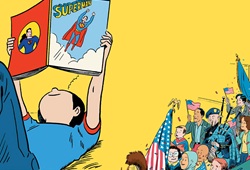
Art by Chuan Ming Ong
In 2006, the Andrew Carnegie Foundation launched its Great Immigrants, Great Americans public awareness initiative, which has honored more than 790 naturalized American citizens from 120 countries over a span of twenty years. The program also serves a way to honor the legacy of Andrew Carnegie, who immigrated to the United States in 1848 at the age of twelve, found success in the steel industry and then donated ninety percent of his fortune to numerous charities and foundations.
In commemoration of the twentieth anniversary of Great Immigrants, Great Americans, the Andrew Carnegie Foundation created a comic series that included a downloadable comic book featuring over a dozen individual stories, three original animations, and lesson plans produced by the National Council of Teachers of English for educators in grades six through twelve.
“This project came about as a result of the interest we received from educators around teaching with comics,” NCTE member Sarah Miller explained during the “Teaching with Comics to Celebrate Immigrant Stories” panel at San Diego Comic-Con in July 2026. “So our executive director started looking for opportunities.” The Andrew Carnegie Foundation’s Great Immigrants, Great Americans series was ultimately selected. The NCTE then tasked a cohort of its members to create lesson plans based on the comic book.
“We had a real quick six weeks where we just jumped in and did everything real fast,” Miller said of the cohort. “And it was a great opportunity to really see what we could create and what we could do together. They wrote together, they revised together, and then we ended up with our resources. We will be continuing to do this work. We started another cohort through another connection with the Library of Congress. We’re going to be using their comics serials collection to get a little bit deeper into using comics as a primary source.”
According to cohort member Peter Carlson, Great Immigrants, Great Americans was the perfect initial project. “It’s a comic collection, they’re each about two pages, about these immigrant stories,” he explained at San Diego Comic-Con. “And we wanted to fashion educator resources so that people could readily bring these stories into students. Many of these stories, if you look at the collection in total, no matter what students you are, you will find windows and mirrors in these texts. You will find places that students can leap through and find other perspectives, other lives, and find enrichment in that empathetically. Or they will also find stories like their own, the story that might not have been found in the rest of their curriculum. So they’re very worthwhile groups to look over. And having those stories, those texts, along with the resources, are really built to just help teachers out there bring these stories and then comics as a medium in general to your classroom.”
That last point was important to the cohort. “The final foundation of this work is really implementing a comics pedagogy,” Carlson said. “As you go through all of the resources, you will find some that are teaching about comics, and that’s where you show the glossary and the background of how comics are made, the structure of them, the history of them, their impact. But then you’ll also find teaching with comics, that’s just putting the comic as the text, whether it’s a supplemental text or it is the central text of the lesson or the unit. And finally, there’ll be several activities or lessons that have teaching through comics, where the students are making comics, and those comics as a processing tool might be to get from one idea to the next, or it might be the end of the lesson or the end of the unit with the students making a full comic on their own.”
The lesson plans created by the National Council of Teachers of English’s cohort do indeed run the gamut, from using Great Immigrants, Great Americans as a starting point for exploring specific waves of immigration into the United States and then creating a comic book based on what was learned, to analyzing the use of meaning and subtext in the various narratives, to gaining a better understanding of how comic books work as a cognitive medium.
As for the naturalized American citizens featured in Great Immigrants, Great Americans, the list includes mathematician Terence Tao, biochemist Katalin Karikó, Pulitzer Prize-winning poet Paul Muldoon, lead singer David Byrne from the Talking Heads, stand-up comedian Mo Amer, comic book artist Jim Lee, and Betty Kwan Chinn, who has helped provide transitional housing, employment, and family services to those in need in Eureka, California, since 1980.
Cohort member Anna Osborn noted during the “Teaching with Comics to Celebrate Immigrant Stories” panel at San Diego Comic-Con that she sent the Great Immigrants, Great Americans comic book to every faculty member at her school, pointing out the wide-range of individuals profiled and how it could be used as a teaching tool in almost any class as a result. Osborn also created two lesson plans for Great Immigrants, Great Americans, one of which is entitled “The Value that Immigrants Bring to Our Community: A Socratic Seminar.”
“Some of the resources I put in there were headlines, not just during the current administration, but during previous administrations,” she said of the lesson plan. “We know from history that we have been in this place before, where immigrants are villainized, where immigrants are not valued. And so just to teach my kids the historical context, that it’s happened before, even if we get through it, it may happen again. So I did go through and I read all the comics, and I pulled words that I thought were values of immigrants. But again, we want to encourage everybody to make these lesson plans their own.”
In addition to identifying words that she personally considered important, Anna Osborn also created a worksheet for students so that they could not only choose their own words but identify the conflicts and hurdles each immigrant experienced and uncover the qualities that enabled them to succeed after they arrived in the United States.
The naturalized Americans featured in Great Immigrants, Great Americans did more than just succeed, however, as they made an impact on their adopted country as well. The same can be said of the National Council of Teachers of English and their collection of cohorts who were able to turn those immigrant stories into valuable learning tools for schools across the country.
Anthony Letizia
Explore more Education Initiatives on Remixing History